Iraq
 Iraq
Iraq⌘K
Overview
- Background
- Formerly part of the Ottoman Empire, Iraq was occupied by the United Kingdom during World War I and was declared a League of Nations mandate under UK administration in 1920. Iraq attained its independence as a kingdom in 1932. It was proclaimed a republic in 1958 after a coup overthrew the monarchy, but in actuality, a series of strongmen ruled the country until 2003. The last was SADDAM Hussein, from 1979 to 2003. Territorial disputes with Iran led to an inconclusive and costly war from 1980 to 1988. In 1990, Iraq seized Kuwait but was expelled by US-led UN coalition forces during the two-month-long Gulf War of 1991. After Iraq's expulsion, the UN Security Council (UNSC) required Iraq to scrap all weapons of mass destruction and long-range missiles and to allow UN verification inspections. Continued Iraqi noncompliance with UNSC resolutions led to the Second Gulf War in 2003, when US-led forces ousted the SADDAM regime.
In 2005, Iraqis approved a constitution in a national referendum and elected a 275-member Council of Representatives (COR). The COR approved most of the cabinet ministers, marking the transition to Iraq's first constitutional government in nearly a half-century. Iraq's constitution also established the Kurdistan Regional Government (KRG), a semi-autonomous region that administers the governorates of Erbil, Dahuk, and As Sulaymaniyah. Iraq has held four national legislative elections since 2006, most recently in 2021. The COR approved Mohammad Shia' al-SUDANI as prime minister in 2022. Iraq has repeatedly postponed elections for provincial councils -- last held in 2013 -- and since 2019, the prime minister has had the authority to appoint governors rather than provincial councils.
Between 2014 and 2017, Iraq fought a military campaign against the Islamic State of Iraq and ash-Sham (ISIS) to recapture territory the group seized in 2014. In 2017, then-Prime Minister Haydar al-ABADI publicly declared victory against ISIS, although military operations against the group continue in rural areas. Also in 2017, Baghdad forcefully seized disputed territories across central and northern Iraq from the KRG, after a non-binding Kurdish independence referendum.
Geography
Area
- Land
- 437,367 sq km
- Water
- 950 sq km
- Total
- 438,317 sq km
- Climate
- mostly desert; mild to cool winters with dry, hot, cloudless summers; northern mountainous regions along Iranian and Turkish borders experience cold winters with occasionally heavy snows that melt in early spring, sometimes causing extensive flooding in central and southern Iraq
- Terrain
- mostly broad plains; reedy marshes along Iranian border in south with large flooded areas; mountains along borders with Iran and Turkey
Land Use
- Other
- 76.5% (2023 est.)
- Forest
- 1.6% (2023 est.)
- Agricultural land
- 21.8% (2023 est.)
- Agricultural land: arable land
- arable land: 11.4% (2023 est.)
- Agricultural land: permanent crops
- permanent crops: 1.2% (2023 est.)
- Agricultural land: permanent pasture
- permanent pasture: 9.2% (2023 est.)
- Location
- Middle East, bordering the Persian Gulf, between Iran and Kuwait
- Coastline
- 58 km
Elevation
- Lowest point
- Persian Gulf 0 m
- Highest point
- Cheekha Dar (Kurdish for "Black Tent") 3,611 m
- Mean elevation
- 312 m
- Irrigated land
- 35,250 sq km (2012)
- Major aquifers
- Arabian Aquifer System
- Map references
- Middle East
Land Boundaries
- Total
- 3,809 km
- Border countries
- Iran 1,599 km; Jordan 179 km; Kuwait 254 km; Saudi Arabia 811 km; Syria 599 km; Turkey 367 km
Maritime Claims
- Territorial sea
- 12 nm
- Continental shelf
- not specified
- Natural hazards
- dust storms; sandstorms; floods
- Geography note
- strategic location on Shatt al Arab waterway and at the head of the Persian Gulf
- Natural resources
- petroleum, natural gas, phosphates, sulfur
- Area comparative
- slightly more than three times the size of New York State
- Geographic coordinates
- 33 00 N, 44 00 E
- Population distribution
- population is concentrated in the north, center, and eastern parts of the country, with many of the larger urban agglomerations found along extensive parts of the Tigris and Euphrates Rivers; much of the western and southern areas are either lightly populated or uninhabited
Major Lakes (Area Sq Km)
- Fresh water lake(s)
- Lake Hammar - 1,940 sq km
Major Watersheds (Area Sq Km)
- Indian ocean drainage
- (Persian Gulf) Tigris and Euphrates (918,044 sq km)
- Major rivers (BY length in km)
- Euphrates river mouth (shared with Turkey[s], Syria, and Iran) - 3,596 km; Tigris river mouth (shared with Turkey[s], Syria, and Iran) - 1,950 km; the Tigris and Euphrates join to form the Shatt al Arab
note: [s] after country name indicates river source; [m] after country name indicates river mouth
People & Society
Literacy
- Male
- 90.3% (2021 est.)
- Female
- 77.8% (2021 est.)
- Total population
- 84.1% (2021 est.)
Languages
- Languages
- Arabic (official), Kurdish (official); Turkmen (a Turkish dialect) and Syriac (Neo-Aramaic) are recognized as official languages where native speakers of these languages are present
- Major language sample(s)
كتاب حقائق العالم، أحسن مصدر للمعلومات الأساسية (Arabic)
ڕاستییەکانی جیهان، باشترین سەرچاوەیە بۆ زانیارییە بنەڕەتییەکان (Kurdish)
The World Factbook, the indispensable source for basic information.
- Religions
- Muslim (official) 95-98% (Shia 61-64%, Sunni 29-34%), Christian 1% (includes Catholic, Orthodox, Protestant, Assyrian Church of the East), other 1-4% (2015 est.)
Sex Ratio
- At birth
- 1.05 male(s)/female
- 0 14 years
- 1.04 male(s)/female
- 15 64 years
- 1.01 male(s)/female
- Total population
- 1.02 male(s)/female (2024 est.)
- 65 years and over
- 0.8 male(s)/female
- Birth rate
- 23.26 births/1,000 population (2025 est.)
- Death rate
- 3.86 deaths/1,000 population (2025 est.)
Median Age
- Male
- 22 years
- Total
- 22.7 years (2025 est.)
- Female
- 22.7 years
Population
- Male
- 21,614,894
- Total
- 42,917,742 (2025 est.)
- Female
- 21,302,848
Nationality
- Noun
- Iraqi(s)
- Adjective
- Iraqi
Tobacco Use
- Male
- 36.2% (2025 est.)
- Total
- 18.6% (2025 est.)
- Female
- 1.3% (2025 est.)
Urbanization
- Urban population
- 71.6% of total population (2023)
- Rate of urbanization
- 2.91% annual rate of change (2020-25 est.)
Age Structure
- 0 14 years
- 34.6% (male 7,447,266/female 7,130,883)
- 15 64 years
- 61.7% (male 13,064,516/female 12,907,702)
- 65 years and over
- 3.6% (2024 est.) (male 681,574/female 851,495)
- Ethnic groups
- Arab 75-80%, Kurdish 15-20%, other 5% (includes Turkmen, Yezidi, Shabak, Kaka'i, Bedouin, Romani, Assyrian, Circassian, Sabaean-Mandaean, Persian)
Child Marriage
- Women married BY age 15
- 7.2% (2018)
- Women married BY age 18
- 27.9% (2018)
Dependency Ratios
- Total dependency ratio
- 60.5 (2025 est.)
- Youth dependency ratio
- 54.6 (2025 est.)
- Potential support ratio
- 16.9 (2025 est.)
- Elderly dependency ratio
- 5.9 (2025 est.)
- Physician density
- 1.02 physicians/1,000 population (2022)
Health Expenditure
- Health expenditure (as % of GDP)
- 5.2% of GDP (2021)
- Health expenditure (as % of national budget)
- 5.8% of national budget (2022 est.)
- Net migration rate
- 0 migrant(s)/1,000 population (2025 est.)
- Hospital bed density
- 1.3 beds/1,000 population (2021 est.)
- Total fertility rate
- 3.03 children born/woman (2025 est.)
Drinking Water Source
- Improved: rural
- rural: 94.8% of population (2022 est.)
- Improved: total
- total: 98.4% of population (2022 est.)
- Improved: urban
- urban: 99.8% of population (2022 est.)
- Unimproved: rural
- rural: 5.2% of population (2022 est.)
- Unimproved: total
- total: 1.6% of population (2022 est.)
- Unimproved: urban
- urban: 0.2% of population (2022 est.)
- Education expenditure
- 4.7% of GDP (2016)
Infant Mortality Rate
- Male
- 20.4 deaths/1,000 live births
- Total
- 18.3 deaths/1,000 live births (2025 est.)
- Female
- 17 deaths/1,000 live births
- Population growth rate
- 1.94% (2025 est.)
- Gross reproduction rate
- 1.48 (2025 est.)
- Population distribution
- population is concentrated in the north, center, and eastern parts of the country, with many of the larger urban agglomerations found along extensive parts of the Tigris and Euphrates Rivers; much of the western and southern areas are either lightly populated or uninhabited
Life Expectancy at Birth
- Male
- 71.9 years
- Female
- 75.7 years
- Total population
- 73.7 years (2024 est.)
- Maternal mortality ratio
- 66 deaths/100,000 live births (2023 est.)
Sanitation Facility Access
- Improved: rural
- rural: 97.6% of population (2022 est.)
- Improved: total
- total: 98.5% of population (2022 est.)
- Improved: urban
- urban: 98.8% of population (2022 est.)
- Unimproved: rural
- rural: 2.4% of population (2022 est.)
- Unimproved: total
- total: 1.5% of population (2022 est.)
- Unimproved: urban
- urban: 1.2% of population (2022 est.)
Alcohol Consumption Per Capita
- Beer
- 0.11 liters of pure alcohol (2019 est.)
- Wine
- 0 liters of pure alcohol (2019 est.)
- Total
- 0.16 liters of pure alcohol (2019 est.)
- Spirits
- 0.04 liters of pure alcohol (2019 est.)
- Other alcohols
- 0 liters of pure alcohol (2019 est.)
- Major urban areas population
- 7.711 million BAGHDAD (capital), 1.792 million Mosul, 1.448 million Basra, 1.075 million Kirkuk, 958,000 Najaf, 897,000 Erbil (2023)
- Obesity adult prevalence rate
- 30.4% (2016)
- Currently married women (ages 15 49)
- 64.3% (2018 est.)
- Children under the age of 5 years underweight
- 3.9% (2018 est.)
Government
Civica · structure
How power is organised
ExecutiveLegislative
- Flag
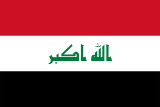
- description: three equal horizontal bands of red (top), white, and black; the Takbir (Arabic phrase meaning "God is great") in green Arabic script is centered in the white band
meaning: the colors come from the Arab Liberation flag and stand for oppression (black) overcome through bloody struggle (red), to be replaced by a bright future (white)
history: the Council of Representatives approved this flag in 2008 as a compromise replacement for the Ba'thist SADDAM-era flag
Capital
- Name
- Baghdad
- Etymology
- the origin of the name is unclear; it may mean "gift of God," from the pre-Islamic words bagh (god) and dad (given)
- Time difference
- UTC+3 (8 hours ahead of Washington, DC, during Standard Time)
- Geographic coordinates
- 33 20 N, 44 24 E
- Suffrage
- 18 years of age; universal
Citizenship
- Citizenship BY birth
- no
- Citizenship BY descent only
- at least one parent must be a citizen of Iraq
- Dual citizenship recognized
- yes
- Residency requirement for naturalization
- 10 years
Constitution
- History
- several previous; latest adopted by referendum 15 October 2005
- Amendment process
- proposed by the president of the republic and the Council of Minsters collectively, or by one fifth of the Council of Representatives members; passage requires at least two-thirds majority vote by the Council of Representatives, approval by referendum, and ratification by the president; passage of amendments to articles on citizen rights and liberties requires two-thirds majority vote of Council of Representatives members after two successive electoral terms, approval in a referendum, and ratification by the president
Country Name
- Former
- Mesopotamia, Mandatory Iraq, Hashemite Kingdom of Iraq
- Etymology
- the name probably derives from Uruk ("Erech" in Aramaic), the ancient Sumerian and Babylonian city on the Euphrates River
- Local long form
- Jumhuriyat al-Iraq/Komar-i Eraq
- Local short form
- Al Iraq/Eraq
- Conventional long form
- Republic of Iraq
- Conventional short form
- Iraq
- Independence
- 3 October 1932 (from League of Nations mandate under British administration)
- Legal system
- mixed system of civil and Islamic law
- Government type
- federal parliamentary republic
Judicial Branch
- Note
- note: Federal Supreme Court jurisdiction limited to constitutional issues, application of federal laws, ratification of election results for the COR, judicial competency disputes, and disputes between regions or governorates and the central government
- Highest court(s)
- Federal Supreme Court or FSC (consists of 9 judges); Court of Cassation (consists of a court president, 5 vice presidents, and at least 24 judges)
- Subordinate courts
- Courts of Appeal (governorate level); civil courts, including first instance, personal status, labor, and customs; criminal courts including felony, misdemeanor, investigative, major crimes, juvenile, and traffic courts
- Judge selection and term of office
- Federal Supreme Court (FSC) judges nominated by the High Judicial Council (HJC) president, the FSC chief justice, the public prosecutor's office chief, and the head of the Judicial Oversight Commission; FSC members required to retire at age 72; Court of Cassation judges appointed by the HJC and confirmed by the Council of Representatives to serve until retirement, nominally at age 63, but can be extended to age 66
Executive Branch
- Cabinet
- Council of Ministers proposed by the prime minister, approved by Council of Representatives (COR)
- Chief of state
- President Latif RASHID (since 13 October 2022)
- Election results
2022: Latif RASHID elected president in second round; COR vote in first round - Latif RASHID (PUK) 157, Barham SALIH (PUK) 99; COR vote in second round - Latif RASHID 167, Barham SALIH 99; Mohammed Shia' al-SUDANI approved as prime minister
2018: Barham SALIH elected president in second round; COR vote in first round - Barham SALIH (PUK) 165, Fuad HUSAYN (KDP) 90; COR vote in second round - Barham SALIH 219, Fuad HUSAYN 22; Adil ABD AL-MAHDI approved as prime minister- Head of government
- Prime Minister Mohammed Shia al-SUDANI (since 27 October 2022)
- Most recent election date
- 13 October 2022
- Election/appointment process
- president indirectly elected by COR to serve a 4-year term (eligible for a second term)
- National holiday
- Independence Day, 3 October (1932); Republic Day, 14 July (1958)
- National color(s)
- red, white, black
National Heritage
- Total world heritage sites
- 6 (5 cultural, 1 mixed)
- Selected world heritage site locales
- Ashur (Qal'at Sherqat) (c); Babylon (c); Erbil Citadel (c); Hatra (c); Samarra Archaeological City (c); The Ahwar (Marshland) of Southern Iraq: Refuge of Biodiversity and the Relict Landscape of the Mesopotamian Cities (m)
- Political parties
- Al Fatah Alliance
Azm Alliance
Babiliyun Movement
Imtidad
Ishraqat Konun
Kurdistan Democratic Party
National Contract Party
New Generation Movement
Patriotic Union of Kurdistan
Sadrist Bloc
State Forces Alliance
State of Law Coalition
Taqadum
Tasmim Alliance
Legislative Branch
- Term in office
- 4 years
- Number of seats
- 329 (all directly elected)
- Electoral system
- other systems
- Legislature name
- Council of Representatives of Iraq
- Scope of elections
- full renewal
- Legislative structure
- unicameral
- Most recent election date
- 11/11/2025
- Expected date of next election
- November 2029
- Percentage of women in chamber
- 28.9%
- Parties elected and seats per party
- Reconstruction & Development Coalition, The Progress (Taqaddum) Party, State of Law Coalition, Sadiqoun Movement, Kurdistan Democratic Party (KDP), Badr Organization, National State Forces Alliance, Patriotic Union of Kurdistan (PUK), Azm Alliance, National Sovereignty, Ishraqat Kanun, Asas (Iraqi Foundation) Coalition, Tasmeem Alliance, Huquq Movement, National Resolve (Hasm)
National Anthem(s)
- Title
- "Mawtini" (My Homeland)
- History
- adopted 2004, after the ouster of SADDAM Husayn; popular Arab folk song that also serves as an unofficial anthem for the Palestinian people
- Lyrics/music
- Ibrahim TOUQAN/Mohammad FLAYFEL
- National symbol(s)
- golden eagle
- Administrative divisions
- 19 governorates (muhafazat, singular - muhafazah (Arabic); parezgakan, singular - parezga (Kurdish)); 'Al Anbar; Al Basrah; Al Muthanna; Al Qadisiyah (Ad Diwaniyah); An Najaf; Arbil (Erbil) (Arabic), Halabjah; Hewler (Kurdish); As Sulaymaniyah (Arabic), Slemani (Kurdish); Babil; Baghdad; Dahuk (Arabic), Dihok (Kurdish); Dhi Qar; Diyala; Karbala'; Kirkuk; Maysan; Ninawa; Salah ad Din; Wasit
Diplomatic Representation in the US
- Fax
- [1] (202) 462-8815
- Chancery
- 1801 P Street NW, Washington, DC 20036
- Telephone
- [1] (202) 483-7500
- Chief of mission
- Ambassador Nazar Issa Abdulhadi AL-KHIRULLAH (since 30 June 2023)
- Consulate(s) general
- Detroit, Los Angeles
- Email address and website
washington@scrdiraq.gov.iq
https://www.iraqiembassy.us/
Diplomatic Representation from the US
- Embassy
- Al-Kindi Street, International Zone, Baghdad; note - consulate in Al Basrah closed as of 28 September 2018
- Telephone
- 0760-030-3000
- Mailing address
- 6060 Baghdad Place, Washington DC 20521-6060
- Chief of mission
- Ambassador (vacant); Chargé d'Affaires Ambassador Joshua HARRIS (since 2 September 2025)
- Email address and website
BaghdadACS@state.gov
https://iq.usembassy.gov/
- International organisations
- ABEDA, AFESD, AIIB, AMF, CAEU, CICA, EITI (compliant country), FAO, G-77, IAEA, IBRD, ICAO, ICRM, IDA, IDB, IFAD, IFC, IFRCS, ILO, IMF, IMO, IMSO, Interpol, IOC, IPU, ISO, ITSO, ITU, LAS, MIGA, NAM, OAPEC, OIC, OPCW, OPEC, PCA, UN, UNCTAD, UNESCO, UNIDO, UNWTO, UPU, WCO, WFTU (NGOs), WHO, WIPO, WMO, WTO (observer)
- International law organization participation
- has not submitted an ICJ jurisdiction declaration; non-party state to the ICCt
Legislature
IRAQ · LEGISLATURE
Council of Representatives of Iraq
329 seats · hover a seat for the party
Total seats
329
Majority line
166
Largest party
Others
Parties
11
All political parties
Leaders
Current
Abdul Latif Rashid
- Head of State
Muhammad Shia' al-Sudani
- Head of Government
Economy
Budget
- Note
- note: central government revenues and expenses (excluding grants/extrabudgetary units/social security funds) converted to US dollars at average official exchange rate for year indicated
- Revenues
- $90.204 billion (2019 est.)
- Expenditures
- $64.512 billion (2019 est.)
Exports
- Civica canonical (reconciled)
- $104.9B
- Note
- note: balance of payments - exports of goods and services in current dollars
- Exports 2021
- $78.26 billion (2021 est.)
- Exports 2022
- $127.079 billion (2022 est.)
- Exports 2023
- $107.852 billion (2023 est.)
Imports
- Civica canonical (reconciled)
- $92.8B
- Note
- note: balance of payments - imports of goods and services in current dollars
- Imports 2021
- $50.707 billion (2021 est.)
- Imports 2022
- $69.162 billion (2022 est.)
- Imports 2023
- $81.179 billion (2023 est.)
- Industries
- petroleum, chemicals, textiles, leather, construction materials, food processing, fertilizer, metal fabrication/processing
- Labor force
- 12.008 million (2024 est.)
Public Debt
- Civica canonical (reconciled)
- 27.4%
- Note
- note: central government debt as a % of GDP
- Public debt 2018
- 27.4% of GDP (2018 est.)
Remittances
- Note
- note: personal transfers and compensation between resident and non-resident individuals/households/entities
- Remittances 2021
- 0.4% of GDP (2021 est.)
- Remittances 2022
- 0.4% of GDP (2022 est.)
- Remittances 2023
- 0.4% of GDP (2023 est.)
Exchange Rates
- Currency
- Iraqi dinars (IQD) per US dollar -
- Exchange rates 2020
- 1,192 (2020 est.)
- Exchange rates 2021
- 1,450 (2021 est.)
- Exchange rates 2022
- 1,450 (2022 est.)
- Exchange rates 2023
- 1,312.5 (2023 est.)
- Exchange rates 2024
- 1,300 (2024 est.)
Debt External
- Note
- note: present value of external debt in current US dollars
- Debt external 2023
- $15.58 billion (2023 est.)
- Economic overview
- highly oil-dependent Middle Eastern economy; fiscal sustainability subject to fluctuation in oil prices; rising public confidence in economic conditions; import-dependent for most sectors; persistent challenges of corruption, informal markets, banking access, and political fragility
Unemployment Rate
- Civica canonical (reconciled)
- 15.5%
- Note
- note: % of labor force seeking employment
- Unemployment rate 2022
- 15.6% (2022 est.)
- Unemployment rate 2023
- 15.5% (2023 est.)
- Unemployment rate 2024
- 15.6% (2024 est.)
- Exports partners
- China 33%, India 28%, USA 8%, Greece 5%, UAE 5% (2023)
- Imports partners
- UAE 32%, China 20%, Turkey 18%, India 5%, USA 2% (2023)
Real GDP Per Capita
- Civica canonical (reconciled)
- $14,464
- Note
- note: data in 2021 dollars
- Real GDP per capita 2022
- $13,400 (2022 est.)
- Real GDP per capita 2023
- $13,200 (2023 est.)
- Real GDP per capita 2024
- $12,700 (2024 est.)
Real GDP Growth Rate
- Civica canonical (reconciled)
- -1.5%
- Note
- note: annual GDP % growth based on constant local currency
- Real GDP growth rate 2022
- 8% (2022 est.)
- Real GDP growth rate 2023
- 0.5% (2023 est.)
- Real GDP growth rate 2024
- -1.5% (2024 est.)
- Agricultural products
- wheat, dates, maize, tomatoes, rye, grapes, milk, chicken, potatoes, fruits (2023)
- Exports commodities
- crude petroleum, refined petroleum, petroleum coke, gold, natural gas (2023)
- Imports commodities
- refined petroleum, cars, broadcasting equipment, jewelry, gold (2023)
Current Account Balance
- Civica canonical (reconciled)
- $8.4B
- Note
- note: balance of payments - net trade and primary/secondary income in current dollars
- Current account balance 2021
- $24.565 billion (2021 est.)
- Current account balance 2022
- $58.01 billion (2022 est.)
- Current account balance 2023
- $28.375 billion (2023 est.)
- Taxes and other revenues
- 1.3% (of GDP) (2019 est.)
- GDP (official exchange rate)
- $279.641 billion (2024 est.)
GDP Composition, BY End Use
- Note
- note: figures may not total 100% due to rounding or gaps in data collection
- Household consumption
- 41.2% (2024 est.)
- Government consumption
- 20.3% (2024 est.)
- Investment in inventories
- 8.8% (2024 est.)
- Investment in fixed capital
- 20.6% (2024 est.)
- Exports of goods and services
- 37.5% (2024 est.)
- Imports of goods and services
- -37.2% (2024 est.)
Average Household Expenditures
- On food
- 28.7% of household expenditures (2023 est.)
- On alcohol and tobacco
- 4.3% of household expenditures (2023 est.)
Inflation Rate (Consumer Prices)
- Civica canonical (reconciled)
- -12.3%
- Note
- note: annual % change based on consumer prices
- Inflation rate (consumer prices) 2021
- 6% (2021 est.)
- Inflation rate (consumer prices) 2022
- 5% (2022 est.)
- Inflation rate (consumer prices) 2023
- 4.4% (2023 est.)
- Industrial production growth rate
- -2.7% (2024 est.)
Real GDP (Purchasing Power Parity)
- Civica canonical (reconciled)
- $585.887 billion (2024 est.)
- Note
- note: data in 2021 dollars
- Real GDP (purchasing power parity) 2022
- $592.017 billion (2022 est.)
- Real GDP (purchasing power parity) 2023
- $595.082 billion (2023 est.)
- Real GDP (purchasing power parity) 2024
- $585.887 billion (2024 est.)
Youth Unemployment Rate (Ages 15 24)
- Male
- 27.5% (2024 est.)
- Note
- note: % of labor force ages 15-24 seeking employment
- Total
- 32.1% (2024 est.)
- Female
- 62.7% (2024 est.)
Reserves of Foreign Exchange and Gold
- Note
- note: holdings of gold (year-end prices)/foreign exchange/special drawing rights in current dollars
- Reserves of foreign exchange and gold 2022
- $97.009 billion (2022 est.)
- Reserves of foreign exchange and gold 2023
- $112.233 billion (2023 est.)
- Reserves of foreign exchange and gold 2024
- $100.691 billion (2024 est.)
GDP Composition, BY Sector of Origin
- Note
- note: figures may not total 100% due to non-allocated consumption not captured in sector-reported data
- Industry
- 51.6% (2024 est.)
- Services
- 45.8% (2024 est.)
- Agriculture
- 3.4% (2024 est.)
Household Income or Consumption BY Percentage Share
- Note
- note: % share of income accruing to lowest and highest 10% of population
- Lowest 10%
- 3.7% (2023 est.)
- Highest 10%
- 24.2% (2023 est.)
Gini Index Coefficient Distribution of Family Income
- Note
- note: index (0-100) of income distribution; higher values represent greater inequality
- Gini index coefficient distribution of family income 2023
- 29.8 (2023 est.)
Energy
Coal
- Imports
- 3,000 metric tons (2023 est.)
Petroleum
- Total petroleum production
- 4.448 million bbl/day (2023 est.)
- Crude oil estimated reserves
- 145.019 billion barrels (2021 est.)
- Refined petroleum consumption
- 1.043 million bbl/day (2023 est.)
Electricity
- Imports
- 3.134 billion kWh (2023 est.)
- Consumption
- 73.521 billion kWh (2023 est.)
- Installed generating capacity
- 31.339 million kW (2023 est.)
- Transmission/distribution losses
- 79.904 billion kWh (2023 est.)
Natural Gas
- Imports
- 8.771 billion cubic meters (2023 est.)
- Production
- 10.537 billion cubic meters (2023 est.)
- Consumption
- 19.308 billion cubic meters (2023 est.)
- Proven reserves
- 3.729 trillion cubic meters (2021 est.)
Electricity Access
- Electrification total population
- 100% (2022 est.)
Energy Consumption Per Capita
- Total energy consumption per capita 2023
- 64.311 million Btu/person (2023 est.)
Electricity Generation Sources
- Solar
- 0.3% of total installed capacity (2023 est.)
- Fossil fuels
- 98.8% of total installed capacity (2023 est.)
- Hydroelectricity
- 0.9% of total installed capacity (2023 est.)
Communications
Internet Users
- Percent of population
- 82% (2023 est.)
- Broadcast media
- the number of private radio and TV stations has increased rapidly since 2003; state-owned TV and radio stations are operated by the publicly funded Iraqi Media Network; private broadcast media are mostly linked to political, ethnic, or religious groups; satellite TV is available to about 70% of viewers; many broadcasters are based abroad; transmissions of multiple international radio broadcasters are accessible (2019)
- Internet country code
- .iq
Telephones Fixed Lines
- Total subscriptions
- 1.977 million (2023 est.)
- Subscriptions per 100 inhabitants
- 4 (2023 est.)
Telephones Mobile Cellular
- Total subscriptions
- 46.1 million (2024 est.)
- Subscriptions per 100 inhabitants
- 100 (2024 est.)
Broadband Fixed Subscriptions
- Total
- 7.77 million (2023 est.)
- Subscriptions per 100 inhabitants
- 17 (2023 est.)
Transport
Ports
- Large
- 0
- Small
- 1
- Medium
- 1
- Key ports
- Al Basrah, Al-Basra Oil Terminal, Khawr Al Amaya, Khawr Al Zubair, Umm Qasr
- Very small
- 4
- Total ports
- 6 (2024)
- Ports with oil terminals
- 3
- Airports
- 73 (2025)
Railways
- Total
- 2,272 km (2014)
- Standard gauge
- 2,272 km (2014) 1.435-m gauge
- Heliports
- 10 (2025)
Merchant Marine
- Total
- 74 (2023)
- BY type
- general cargo 1, oil tanker 6, other 67
- Civil aircraft registration country code prefix
- YI
Environment
- Climate
- mostly desert; mild to cool winters with dry, hot, cloudless summers; northern mountainous regions along Iranian and Turkish borders experience cold winters with occasionally heavy snows that melt in early spring, sometimes causing extensive flooding in central and southern Iraq
Land Use
- Other
- 76.5% (2023 est.)
- Forest
- 1.6% (2023 est.)
- Agricultural land
- 21.8% (2023 est.)
- Agricultural land: arable land
- arable land: 11.4% (2023 est.)
- Agricultural land: permanent crops
- permanent crops: 1.2% (2023 est.)
- Agricultural land: permanent pasture
- permanent pasture: 9.2% (2023 est.)
Urbanization
- Urban population
- 71.6% of total population (2023)
- Rate of urbanization
- 2.91% annual rate of change (2020-25 est.)
Methane Emissions
- Other
- 2.3 kt (2019-2021 est.)
- Waste
- 325 kt (2019-2021 est.)
- Energy
- 2,243 kt (2022-2024 est.)
- Agriculture
- 157 kt (2019-2021 est.)
Waste and Recycling
- Municipal solid waste generated annually
- 13.14 million tons (2024 est.)
- Percent of municipal solid waste recycled
- 15.4% (2022 est.)
- Environmental issues
- habitat loss from wetland draining; inadequate potable water; soil degradation (salination) and erosion; desertification; air, soil, and groundwater pollution from military and industries; water pollution from oil refineries and factory and sewage discharges; soil pollution from fertilizer and chemicals; air pollution in urban areas
Total Water Withdrawal
- Municipal
- 6.735 billion cubic meters (2022 est.)
- Industrial
- 4.52 billion cubic meters (2022 est.)
- Agricultural
- 31.169 billion cubic meters (2022 est.)
Carbon Dioxide Emissions
- Total emissions
- 190.815 million metric tonnes of CO2 (2023 est.)
- From consumed natural gas
- 37.878 million metric tonnes of CO2 (2023 est.)
- From coal and metallurgical coke
- 7,000 metric tonnes of CO2 (2023 est.)
- From petroleum and other liquids
- 152.931 million metric tonnes of CO2 (2023 est.)
- Particulate matter emissions
- 45.4 micrograms per cubic meter (2019 est.)
- Total renewable water resources
- 89.86 billion cubic meters (2022 est.)
International Environmental Agreements
- Party to
- Biodiversity, Climate Change, Climate Change-Kyoto Protocol, Comprehensive Nuclear Test Ban, Desertification, Endangered Species, Hazardous Wastes, Law of the Sea, Nuclear Test Ban, Ozone Layer Protection, Ship Pollution, Wetlands
- Signed, but not ratified
- Climate Change-Paris Agreement, Environmental Modification
Military & Security
- Military note
- the Iraqi Security Forces (ISF) are primarily focused on internal and border security; they are actively conducting counterinsurgency and counterterrorism operations against the Islamic State of Iraq and ash-Sham (ISIS) terrorist group, particularly in northern and western Iraq; the operations include securing the border with Syria; the Kurdish Security Forces, as well as are also active in conducting operations against ISIS
two international military task forces operate in Iraq to assist the country's security forces at the request of the Iraqi Government; in 2018, NATO established an advisory, training and capacity-building mission for the Iraqi military known as the NATO Mission Iraq (NMI); in December 2021, the US-led Combined Joint Task Force – Operation Inherent Resolve (CJTF-OIR) transitioned from a combat role to an advise, assist, and enable role (2025)
Military Expenditures
- Civica canonical (reconciled)
- 2.4%
- Military expenditures 2020
- 3.2% of GDP (2020 est.)
- Military expenditures 2021
- 3% of GDP (2021 est.)
- Military expenditures 2022
- 1.8% of GDP (2022 est.)
- Military expenditures 2023
- 2.5% of GDP (2023 est.)
- Military expenditures 2024
- 2.5% of GDP (2024 est.)
- Military and security forces
- Ministry of Defense: Iraqi Army, Iraqi Navy, Iraqi Air Force
Office of the Prime Minister: Iraqi Counterterrorism Service (CTS); Popular Mobilization Committee (PMC)
Ministry of Interior: Federal Police Forces Command, Border Guard Forces Command, Federal Intelligence and Investigations Agency, Emergency Response Division, Facilities Protection Directorate, and Provincial Police; Ministry of Oil: Energy Police Directorate (2025) - Military service age and obligation
- 18 years of age for voluntary military service; no conscription (2025)
- Military equipment inventories and acquisitions
- the Iraqi military's inventory includes a mix of European, Russian, Soviet-era, and US armaments (2025)
- Military and security service personnel strengths
- estimated 200,000 active armed forces personnel under the Ministry of Defense (Army, Aviation Command, Air/Air Defense, Navy, Special Forces); approximately 20-25,000 National-Level Security Forces
Ministry of Peshmerga: estimated 150,000 active personnel
Popular Mobilization Forces: estimated 200,000 militia (2025)
Terrorism
- Terrorist group(s)
- Ansar al-Islam; Asa'ib Ahl al-Haq; Islamic Revolutionary Guard Corps (IRGC)/Qods Force; Harakat al-Nujaba (HAN); Harakat Ansar Allah al-Awfiya (HAAA); Islamic State of Iraq and ash-Sham (ISIS); Jaysh Rijal al-Tariq al-Naqshabandi; Kata'ib Hizballah; Kata’ib al-Imam Ali (KIA); Kata’ib Sayyid al-Shuhada (KSS); Kurdistan Workers' Party (PKK)
Transnational Issues
Refugees and Internally Displaced Persons
- Idps
- 1,201,813 (2024 est.)
- Refugees
- 335,343 (2024 est.)
- Stateless persons
- 233 (2024 est.)
Scores & Rankings
ScoreValueGlobal rankTrendAs of
Civica Index24.0 / 100as of 2024-Q4152 / 1902024-Q4
V-Dem Liberal Democracy0.23as of 2024-Q4107 / 1702024-Q4
Freedom House StatusNot Free (25/100)as of 2024-Q4—2024-Q4
Press Freedom (RSF)Partly free (50/100)as of 2024—2024
Cite this page
Cite this page
Civica. (2026). Civica Atlas — Iraq — vintage 2026-Q1: Iraq factbook. Civica Atlas. Retrieved May 7, 2026, from https://civicaatlas.org/factbook/iraq
Sources: FAO FAOSTAT, ILO ILOSTAT, IMF (WEO), UN Statistics Division, UNDP HDR, UNESCO Institute for Statistics, V-Dem, WHO Global Health Observatory, World Bank, WTO Stats, CIA World Factbook, Wikidata