Ecuador
 Ecuador
⌘K
Overview
- Background
- What is now Ecuador formed part of the northern Inca Empire until the Spanish conquest in 1533. Quito -- the traditional name for the area -- became a seat of Spanish colonial government in 1563 and part of the Viceroyalty of New Granada in 1717. The territories of the Viceroyalty -- New Granada (Colombia), Venezuela, and Quito -- gained their independence between 1819 and 1822 and formed a federation known as Gran Colombia. When Quito withdrew to become an independent republic in 1830, the traditional name was changed to the "Republic of the Equator." Between 1904 and 1942, Ecuador lost territories in a series of conflicts with its neighbors. A border war with Peru that flared in 1995 was resolved in 1999. Although Ecuador has had nearly 50 years of civilian governance, the period has been marked by political instability.
Geography
Area
- Land
- 276,841 sq km
- Note
- note: includes Galapagos Islands
- Water
- 6,720 sq km
- Total
- 283,561 sq km
- Climate
- tropical along coast, becoming cooler inland at higher elevations; tropical in Amazonian jungle lowlands
- Terrain
- coastal plain (costa), inter-Andean central highlands (sierra), and flat to rolling eastern jungle (oriente)
Land Use
- Other
- 28.6% (2023 est.)
- Forest
- 49.8% (2023 est.)
- Agricultural land
- 21.5% (2023 est.)
- Agricultural land: arable land
- arable land: 4.1% (2023 est.)
- Agricultural land: permanent crops
- permanent crops: 5.6% (2023 est.)
- Agricultural land: permanent pasture
- permanent pasture: 11.8% (2023 est.)
- Location
- Western South America, bordering the Pacific Ocean at the Equator, between Colombia and Peru
- Coastline
- 2,237 km
Elevation
- Note
- note: because the earth is not a perfect sphere and has an equatorial bulge, the highest point on the planet farthest from its center is Mount Chimborazo not Mount Everest, which is merely the highest peak above sea level
- Lowest point
- Pacific Ocean 0 m
- Highest point
- Chimborazo 6,267
- Mean elevation
- 1,117 m
- Irrigated land
- 12,520 sq km (2022)
- Map references
- South America
Land Boundaries
- Total
- 2,237 km
- Border countries
- Colombia 708 km; Peru 1529 km
Maritime Claims
- Note
- note: Ecuador has declared its right to extend its continental shelf to 350 nm, measured from the baselines of the Galapagos Archipelago
- Territorial sea
- 12 nm
- Continental shelf
- 200 nm
- Exclusive economic zone
- 200 nm
- Natural hazards
- frequent earthquakes; landslides; volcanic activity; floods; periodic droughts
volcanism: volcanic activity concentrated along the Andes Mountains; Sangay (5,230 m) is mainland Ecuador's most active volcano; other historically active volcanoes in the Andes include Antisana, Cayambe, Chacana, Cotopaxi, Guagua Pichincha, Reventador, Sumaco, and Tungurahua; Fernandina (1,476 m), a shield volcano, is the most active of the many Galapagos volcanoes; other historically active Galapagos volcanoes include Wolf, Sierra Negra, Cerro Azul, Pinta, Marchena, and Santiago - Geography note
- Cotopaxi in the Andes is highest active volcano in world
- Natural resources
- petroleum, fish, timber, hydropower
- Area comparative
- slightly smaller than Nevada
- Geographic coordinates
- 2 00 S, 77 30 W
- Population distribution
- nearly half of the population is concentrated in the interior, with large concentrations also found along the western coastal strip; the rainforests of the east remain sparsely populated
Major Watersheds (Area Sq Km)
- Atlantic ocean drainage
- Amazon (6,145,186 sq km)
People & Society
Literacy
- Male
- 96.8% (2022 est.)
- Female
- 95.7% (2022 est.)
- Total population
- 96.3% (2022 est.)
Languages
- Note
- note 1: shares sum to more than 100% because some respondents gave more than one answer on the census
note 2: Quechua and Shuar are official languages of intercultural relations; other indigenous languages are in official use by indigenous peoples in the areas they inhabit - Languages
- Spanish (Castilian; official) 98.6%, indigenous 3.9% (Quechua 3.2%, other indigenous 0.7%), foreign 2.8%, other 0.6% (includes Ecuadorian sign language) (2022 est.)
- Major language sample(s)
La Libreta Informativa del Mundo, la fuente indispensable de información básica. (Spanish)
The World Factbook, the indispensable source for basic information.
- Religions
- Roman Catholic 68.2%, Protestant 19% (Evangelical 18.3%, Adventist 0.6%, other Protestant 0.2%), Jehovah's Witness 1.4%, other 2.3%, none 8.2% don't know/no response 1% (2023 est.)
Sex Ratio
- At birth
- 1.05 male(s)/female
- 0 14 years
- 1.05 male(s)/female
- 15 64 years
- 0.97 male(s)/female
- Total population
- 0.97 male(s)/female (2024 est.)
- 65 years and over
- 0.81 male(s)/female
- Birth rate
- 17.42 births/1,000 population (2025 est.)
- Death rate
- 7.12 deaths/1,000 population (2025 est.)
Median Age
- Male
- 27 years
- Total
- 28.2 years (2025 est.)
- Female
- 28.9 years
Population
- Male
- 9,097,614
- Total
- 18,479,841 (2025 est.)
- Female
- 9,382,227
Nationality
- Noun
- Ecuadorian(s)
- Adjective
- Ecuadorian
Tobacco Use
- Male
- 17.2% (2025 est.)
- Total
- 9.7% (2025 est.)
- Female
- 2.4% (2025 est.)
Urbanization
- Urban population
- 64.8% of total population (2023)
- Rate of urbanization
- 1.62% annual rate of change (2020-25 est.)
Age Structure
- 0 14 years
- 26.8% (male 2,505,729/female 2,395,198)
- 15 64 years
- 64.1% (male 5,771,234/female 5,972,938)
- 65 years and over
- 9.1% (2024 est.) (male 746,207/female 918,678)
- Ethnic groups
- Mestizo (mixed Indigenous and White) 77.5%, Montubio 7.7%, Indigenous 7.7%, White 2.2%, Afroecuadorian 2%, Mulatto 1.4%, Black 1.3%, other 0.1% (2022 est.)
Child Marriage
- Women married BY age 15
- 3.8% (2018)
- Women married BY age 18
- 22.2% (2018)
Dependency Ratios
- Total dependency ratio
- 55.3 (2025 est.)
- Youth dependency ratio
- 41 (2025 est.)
- Potential support ratio
- 7 (2025 est.)
- Elderly dependency ratio
- 14.3 (2025 est.)
- Physician density
- 2.31 physicians/1,000 population (2020)
Health Expenditure
- Health expenditure (as % of GDP)
- 8.3% of GDP (2021)
- Health expenditure (as % of national budget)
- 11.9% of national budget (2022 est.)
- Net migration rate
- -1.23 migrant(s)/1,000 population (2025 est.)
- Hospital bed density
- 1.3 beds/1,000 population (2021 est.)
- Total fertility rate
- 2.17 children born/woman (2025 est.)
Drinking Water Source
- Improved: rural
- rural: 87.9% of population (2022 est.)
- Improved: total
- total: 95.7% of population (2022 est.)
- Improved: urban
- urban: 100% of population (2022 est.)
- Unimproved: rural
- rural: 12.1% of population (2022 est.)
- Unimproved: total
- total: 4.3% of population (2022 est.)
- Unimproved: urban
- urban: 0% of population (2022 est.)
Education Expenditure
- Education expenditure (% GDP)
- 3.9% of GDP (2023 est.)
- Education expenditure (% national budget)
- 15.5% national budget (2025 est.)
Infant Mortality Rate
- Male
- 12.2 deaths/1,000 live births
- Total
- 11.2 deaths/1,000 live births (2025 est.)
- Female
- 10.2 deaths/1,000 live births
- Population growth rate
- 0.91% (2025 est.)
- Gross reproduction rate
- 1.06 (2025 est.)
- Population distribution
- nearly half of the population is concentrated in the interior, with large concentrations also found along the western coastal strip; the rainforests of the east remain sparsely populated
Life Expectancy at Birth
- Male
- 69.7 years
- Female
- 80.4 years
- Total population
- 74.9 years (2024 est.)
- Maternal mortality ratio
- 55 deaths/100,000 live births (2023 est.)
Sanitation Facility Access
- Improved: rural
- rural: 98.2% of population (2022 est.)
- Improved: total
- total: 99.4% of population (2022 est.)
- Improved: urban
- urban: 100% of population (2022 est.)
- Unimproved: rural
- rural: 1.8% of population (2022 est.)
- Unimproved: total
- total: 0.6% of population (2022 est.)
- Unimproved: urban
- urban: 0% of population (2022 est.)
Alcohol Consumption Per Capita
- Beer
- 2.32 liters of pure alcohol (2019 est.)
- Wine
- 0.09 liters of pure alcohol (2019 est.)
- Total
- 3.05 liters of pure alcohol (2019 est.)
- Spirits
- 0.61 liters of pure alcohol (2019 est.)
- Other alcohols
- 0.03 liters of pure alcohol (2019 est.)
- Major urban areas population
- 3.142 million Guayaquil, 1.957 million QUITO (capital) (2023)
- Obesity adult prevalence rate
- 19.9% (2016)
- Currently married women (ages 15 49)
- 45.3% (2022 est.)
- Children under the age of 5 years underweight
- 4.9% (2024 est.)
School Life Expectancy (Primary to Tertiary Education)
- Male
- 14 years (2022 est.)
- Total
- 15 years (2022 est.)
- Female
- 15 years (2022 est.)
Government
Civica · structure
How power is organised
ExecutiveLegislative
- Flag
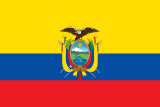
- description: three horizontal bands of yellow (top, double-width), blue, and red, with the coat of arms at the center of the flag
meaning: yellow stands for sunshine, grain, and mineral wealth; blue for the sky, sea, and rivers; red for patriots' blood spilled in the struggle for freedom and justice
Capital
- Name
- Quito
- Etymology
- named after the Quitu, a Pre-Columbian people who lived in the area; the meaning of their name is unknown
- Time zone note
- Ecuador has two time zones, including the Galapagos Islands (UTC-6)
- Time difference
- UTC-5 (same time as Washington, DC, during Standard Time)
- Geographic coordinates
- 0 13 S, 78 30 W
- Suffrage
- 18-65 years of age; universal and compulsory; voluntary for 16-18, over 65, and other eligible voters
Citizenship
- Citizenship BY birth
- yes
- Citizenship BY descent only
- yes
- Dual citizenship recognized
- no
- Residency requirement for naturalization
- 3 years
Constitution
- History
- many previous; latest approved 20 October 2008
- Amendment process
- proposed by the president of the republic through a referendum, by public petition of at least 1% of registered voters, or by agreement of at least one-third membership of the National Assembly; passage requires two separate readings a year apart and approval by at least two-thirds majority vote of the Assembly, and approval by absolute majority in a referendum; amendments such as changes to the structure of the state, constraints on personal rights and guarantees, or constitutional amendment procedures are not allowed
Country Name
- Former
- Quito
- Etymology
- the name is the Spanish word for "equator," referring to its geographic position
- Local long form
- República del Ecuador
- Local short form
- Ecuador
- Conventional long form
- Republic of Ecuador
- Conventional short form
- Ecuador
- Independence
- 24 May 1822 (from Spain)
- Legal system
- civil law based on the Chilean civil code with modifications; traditional law in ethnic communities
- Government type
- presidential republic
Judicial Branch
- Highest court(s)
- National Court of Justice or Corte Nacional de Justicia (consists of 21 judges, including the chief justice and organized into 5 specialized chambers); Constitutional Court or Corte Constitucional (consists of the court president and 8 judges)
- Subordinate courts
- provincial courts (one for each province except Galapagos); fiscal, criminal, and administrative tribunals; Election Dispute Settlement Courts; cantonal courts
- Judge selection and term of office
- candidates for the National Court of Justice evaluated and appointed justices by the Judicial Council, a 9-member independent body of law professionals; justices elected for 9-year, non-renewable terms, with one third of the membership renewed every 3 years; candidates for the Constitutional Court evaluated and appointed judges by a 6-member independent body of law professionals; judges appointed for 4-year renewable terms
Executive Branch
- Note
- note 1: the president is both chief of state and head of government
note 2: though eligible for a second term, former president Guillermo LASSO announced that he would not run in the 2023 election; President Daniel NOBOA Azin is serving out the remainder of the presidential term (2021–2025) - Cabinet
- Cabinet appointed by the president
- Chief of state
- President Daniel NOBOA Azin (since 23 November 2023)
- Election results
2025: Daniel NOBOA Azin reelected president; percent of vote in the first round - Daniel NOBOA Azin (ADN) 44.2%, Luisa GONZÁLEZ Alcivar (MRC) 44%, Leonidas IZA (MUPP) 5.3%, other 6.5%; percent of vote in the second round - Daniel NOBOA Azin 55.6%, Luisa GONZÁLEZ Alcivar 44.4%
2023: Daniel NOBOA Azin elected president; percent of vote in the first round - Luisa GONZÁLEZ Alcivar (MRC) 33.6%, Daniel NOBOA Azin (ADN) 23.5%, Christian Gustavo ZURITA Ron (Construye) 16.4%, Jan Tomislav TOPIĆ Feraud (Por Un País Sin Miedo) 14.7%, Otto Ramón SONNENHOLZNER Sper (Avanza) 7.1%, other 4.7%; percent of vote in the second round - Daniel NOBOA Azin 51.8%, Luisa GONZÁLEZ Alcivar 48.2%
2021: Guillermo LASSO Mendoza elected president; percent of vote in the first round - Andres ARAUZ (UNES) 32.7%, Guillermo LASSO Mendoza (CREO) 19.7%, Yaku PEREZ Guartambel (MUPP) 19.4%, Xavier HERVAS Mora (ID) 15.7%, other 12.5%; percent of vote in the second round - Guillermo LASSO Mendoza (CREO) 52.5%, Andres ARAUZ (UNES) 47.5%- Head of government
- President Daniel NOBOA Azin (since 23 November 2023)
- Most recent election date
- 9 February 2025, with a runoff on 13 April 2025
- Election/appointment process
- president and vice president directly elected on the same ballot by absolute-majority popular vote in 2 rounds, if needed, for a 4-year term (eligible for a second term)
- Expected date of next election
- 28 February 2029
- National holiday
- Independence Day (independence of Quito), 10 August (1809)
- National color(s)
- yellow, blue, red
National Heritage
- Total world heritage sites
- 5 (3 cultural, 2 natural)
- Selected world heritage site locales
- Historic Quito (c); Galápagos Islands (n); Historic Cuenca (c); Qhapaq Ñan/Andean Road System (c); Sangay National Park (n)
- Political parties
- Actuemos Ecuador or Actuemos
AMIGO movement, Independent Mobilizing Action Generating Opportunities (Movimiento AMIGO (Acción Movilizadora Independiente Generando Oportunidades)) or AM16O
Avanza Party or AVANZA
Central Democratic Movement or CD
Citizen Revolution Movement or MRC or RC5
Creating Opportunities Movement or CREO
Democratic Left or ID
Democracy Yes Movement (Movimiento Democracia Si)
For A Country Without Fear (Por Un País Sin Miedo) (an alliance including PSC, CD, and PSP)
Green Movement (Movimiento Verde)
Movimiento Construye or Construye
National Democratic Action (Acción Democrática Nacional) or ADN
Pachakutik Plurinational Unity Movement or MUPP
Patriotic Society Party or PSP
People, Equality, and Democracy Party (Partido Pueblo, Igualdad y Democracia) or PID
Popular Unity Party (Partido Unidad Popular) or UP
Revolutionary and Democratic Ethical Green Movement (Movimiento Verde Ético Revolucionario y Democrático) or MOVER
Social Christian Party or PSC
Socialist Party
Society United for More Action or SUMA
Total Renovation Movement (Movimiento Renovacion Total) or RETO
Legislative Branch
- Note
- note 1: all Assembly members have alternates from the same party who cast votes when a primary member is absent, resigns, or is removed from office
note 2: on 18 May 2023, Ecuador’s National Electoral Council announced that the legislative and presidential elections - originally scheduled for February 2025 - would be held on 20 August 2023 after President Guillermo LASSO dissolved the National Assembly by decree on 17 May 2023; a return to a regular election cycle will occur in February 2025 - Term in office
- 4 years
- Number of seats
- 151 (all directly elected)
- Electoral system
- proportional representation
- Legislature name
- National Assembly (Asamblea Nacional)
- Scope of elections
- full renewal
- Legislative structure
- unicameral
- Most recent election date
- 2/9/2025
- Expected date of next election
- February 2029
- Percentage of women in chamber
- 45%
- Parties elected and seats per party
- Citizen Revolution Movement (RC) - Renewal Movement (RETO) (67); National Democratic Action (ADN) (66); Pachakutik (9); Other (9)
National Anthem(s)
- Title
- "Salve, O Patria!" (We Salute You, Our Homeland)
- History
- adopted 1948; MERA wrote the lyrics in 1865; only the chorus and second verse are sung
- Lyrics/music
- Juan Leon MERA/Antonio NEUMANE
- National symbol(s)
- Andean condor
- Administrative divisions
- 24 provinces (provincias, singular - provincia); Azuay, Bolivar, Cañar, Carchi, Chimborazo, Cotopaxi, El Oro, Esmeraldas, Galapagos, Guayas, Imbabura, Loja, Los Rios, Manabí, Morona Santiago, Napo, Orellana, Pastaza, Pichincha, Santa Elena, Santo Domingo de los Tsachilas, Sucumbios, Tungurahua, Zamora Chinchipe
Diplomatic Representation in the US
- Fax
- [1] (202) 333-2893
- Chancery
- 2535 15th Street NW, Washington, DC 20009
- Telephone
- [1] (202) 234-7200
- Chief of mission
- Ambassador Pablo Agustín ZAMBRANO Albuja (since 24 July 2025)
- Consulate(s) general
- Atlanta, Chicago, Houston, Los Angeles, Miami, Minneapolis (MN), New Haven (CT), New York, Newark (NJ), Phoenix, San Juan (PR)
- Email address and website
eecuusanotifications@mmrree.gob.ec
Contact – Washington (cancilleria.gob.ec)
Diplomatic Representation from the US
- Embassy
- E12-170 Avenida Avigiras y Avenida Eloy Alfaro, Quito
- Telephone
- [593] (2) 398-5000
- Mailing address
- 3420 Quito Place, Washington DC 20521-3420
- Chief of mission
- Ambassador (vacant); Chargé d’Affaires Lawrence PETRONI (since 17 April 2025)
- Consulate(s) general
- Guayaquil
- Email address and website
ACSQuito@state.gov
https://ec.usembassy.gov/
- International organisations
- CAN, CD, CELAC, FAO, G-11, G-77, IADB, IAEA, IBRD, ICAO, ICC (national committees), ICCt, ICRM, IDA, IFAD, IFC, IFRCS, IHO, ILO, IMF, IMO, Interpol, IOC, IOM, IPU, ISO, ITSO, ITU, ITUC (NGOs), LAES, LAIA, Mercosur (associate), MIGA, MINUSTAH, NAM, OAS, OPANAL, OPCW, OPEC, Pacific Alliance (observer), PCA, PROSUR, SICA (observer), UN, UNCTAD, UNESCO, UNHCR, UNIDO, Union Latina, UNISFA, UNMIL, UNMISS, UNOCI, UNOOSA, UNWTO, UPU, WCO, WFTU (NGOs), WHO, WIPO, WMO, WTO
- International law organization participation
- has not submitted an ICJ jurisdiction declaration; accepts ICCt jurisdiction
Legislature
ECUADOR · LEGISLATURE
National Assembly
151 seats · hover a seat for the party
Total seats
151
Majority line
77
Largest party
Citizen Revolution Movement (RC) - Renewal Movement (RETO)
Parties
9
All political parties
Leaders
Current
Daniel Noboa
- Head of State
- Head of Government
Economy
Budget
- Note
- note: central government revenues (excluding grants) and expenditures converted to US dollars at average official exchange rate for year indicated
- Revenues
- $35.962 billion (2022 est.)
- Expenditures
- $35.969 billion (2022 est.)
Exports
- Civica canonical (reconciled)
- $37.8B
- Note
- note: balance of payments - exports of goods and services in current dollars
- Exports 2022
- $36.588 billion (2022 est.)
- Exports 2023
- $35.687 billion (2023 est.)
- Exports 2024
- $38.468 billion (2024 est.)
Imports
- Civica canonical (reconciled)
- $33.6B
- Note
- note: balance of payments - imports of goods and services in current dollars
- Imports 2022
- $36.644 billion (2022 est.)
- Imports 2023
- $35.421 billion (2023 est.)
- Imports 2024
- $33.97 billion (2024 est.)
- Industries
- petroleum, food processing, textiles, wood products, chemicals
- Labor force
- 8.821 million (2024 est.)
Public Debt
- Civica canonical (reconciled)
- 54.4%
- Public debt 2016
- 43.2% of GDP (2016 est.)
Remittances
- Note
- note: personal transfers and compensation between resident and non-resident individuals/households/entities
- Remittances 2022
- 4.1% of GDP (2022 est.)
- Remittances 2023
- 4.5% of GDP (2023 est.)
- Remittances 2024
- 5.2% of GDP (2024 est.)
- Exchange rates
- the US dollar became Ecuador's currency in 2001
Debt External
- Note
- note: present value of external debt in current US dollars
- Debt external 2023
- $39.658 billion (2023 est.)
- Economic overview
- highly informal South American economy; USD currency user; major banana exporter; hard hit by COVID-19; macroeconomic fragility from oil dependency; successful debt restructuring; China funding budget deficits; social unrest hampering economic activity
Unemployment Rate
- Civica canonical (reconciled)
- 3.3%
- Note
- note: % of labor force seeking employment
- Unemployment rate 2022
- 3.8% (2022 est.)
- Unemployment rate 2023
- 3.6% (2023 est.)
- Unemployment rate 2024
- 4.8% (2024 est.)
- Exports partners
- USA 22%, China 21%, Panama 12%, Japan 3%, Peru 3% (2023)
- Imports partners
- USA 27%, China 20%, Colombia 7%, Brazil 4%, Peru 4% (2023)
Real GDP Per Capita
- Civica canonical (reconciled)
- $15,840
- Note
- note: data in 2021 dollars
- Real GDP per capita 2022
- $14,200 (2022 est.)
- Real GDP per capita 2023
- $14,300 (2023 est.)
- Real GDP per capita 2024
- $13,900 (2024 est.)
Real GDP Growth Rate
- Civica canonical (reconciled)
- -2.0%
- Note
- note: annual GDP % growth based on constant local currency
- Real GDP growth rate 2022
- 5.9% (2022 est.)
- Real GDP growth rate 2023
- 2% (2023 est.)
- Real GDP growth rate 2024
- -2% (2024 est.)
- Agricultural products
- bananas, sugarcane, milk, oil palm fruit, maize, rice, plantains, chicken, pineapples, cocoa beans (2023)
- Exports commodities
- crude petroleum, shellfish, bananas, fish, gold (2023)
- Imports commodities
- refined petroleum, coal tar oil, cars, packaged medicine, plastics (2023)
Current Account Balance
- Civica canonical (reconciled)
- $7.0B
- Note
- note: balance of payments - net trade and primary/secondary income in current dollars
- Current account balance 2022
- $2.136 billion (2022 est.)
- Current account balance 2023
- $2.217 billion (2023 est.)
- Current account balance 2024
- $7.082 billion (2024 est.)
- Taxes and other revenues
- 13.1% (of GDP) (2022 est.)
- GDP (official exchange rate)
- $124.676 billion (2024 est.)
GDP Composition, BY End Use
- Note
- note: figures may not total 100% due to rounding or gaps in data collection
- Household consumption
- 64.9% (2024 est.)
- Government consumption
- 13.3% (2024 est.)
- Investment in inventories
- 0.1% (2024 est.)
- Investment in fixed capital
- 18.4% (2024 est.)
- Exports of goods and services
- 30.3% (2024 est.)
- Imports of goods and services
- -26.9% (2024 est.)
- Population below poverty line
- 26% (2023 est.)
Average Household Expenditures
- On food
- 25.9% of household expenditures (2023 est.)
- On alcohol and tobacco
- 0.9% of household expenditures (2023 est.)
Inflation Rate (Consumer Prices)
- Civica canonical (reconciled)
- 1.5%
- Note
- note: annual % change based on consumer prices
- Inflation rate (consumer prices) 2022
- 3.5% (2022 est.)
- Inflation rate (consumer prices) 2023
- 2.2% (2023 est.)
- Inflation rate (consumer prices) 2024
- 1.5% (2024 est.)
- Industrial production growth rate
- -3.7% (2024 est.)
Real GDP (Purchasing Power Parity)
- Civica canonical (reconciled)
- $252.728 billion (2024 est.)
- Note
- note: data in 2021 dollars
- Real GDP (purchasing power parity) 2022
- $252.861 billion (2022 est.)
- Real GDP (purchasing power parity) 2023
- $257.889 billion (2023 est.)
- Real GDP (purchasing power parity) 2024
- $252.728 billion (2024 est.)
Youth Unemployment Rate (Ages 15 24)
- Male
- 8.3% (2024 est.)
- Note
- note: % of labor force ages 15-24 seeking employment
- Total
- 10.1% (2024 est.)
- Female
- 13% (2024 est.)
Reserves of Foreign Exchange and Gold
- Note
- note: holdings of gold (year-end prices)/foreign exchange/special drawing rights in current dollars
- Reserves of foreign exchange and gold 2022
- $8.459 billion (2022 est.)
- Reserves of foreign exchange and gold 2023
- $4.442 billion (2023 est.)
- Reserves of foreign exchange and gold 2024
- $6.908 billion (2024 est.)
GDP Composition, BY Sector of Origin
- Note
- note: figures may not total 100% due to non-allocated consumption not captured in sector-reported data
- Industry
- 26.5% (2024 est.)
- Services
- 57.2% (2024 est.)
- Agriculture
- 9.5% (2024 est.)
Household Income or Consumption BY Percentage Share
- Note
- note: % share of income accruing to lowest and highest 10% of population
- Lowest 10%
- 1.6% (2023 est.)
- Highest 10%
- 33.2% (2023 est.)
Gini Index Coefficient Distribution of Family Income
- Note
- note: index (0-100) of income distribution; higher values represent greater inequality
- Gini index coefficient distribution of family income 2023
- 44.6 (2023 est.)
Energy
Coal
- Exports
- 200 metric tons (2023 est.)
- Imports
- 14,000 metric tons (2023 est.)
- Consumption
- 14,000 metric tons (2023 est.)
- Proven reserves
- 24 million metric tons (2023 est.)
Petroleum
- Total petroleum production
- 480,000 bbl/day (2023 est.)
- Crude oil estimated reserves
- 8.273 billion barrels (2021 est.)
- Refined petroleum consumption
- 272,000 bbl/day (2023 est.)
Electricity
- Exports
- 192 million kWh (2023 est.)
- Imports
- 466 million kWh (2023 est.)
- Consumption
- 29.305 billion kWh (2023 est.)
- Installed generating capacity
- 8.438 million kW (2023 est.)
- Transmission/distribution losses
- 5.119 billion kWh (2023 est.)
Natural Gas
- Production
- 271.053 million cubic meters (2023 est.)
- Consumption
- 271.053 million cubic meters (2023 est.)
- Proven reserves
- 10.902 billion cubic meters (2021 est.)
Electricity Access
- Electrification total population
- 100% (2022 est.)
Energy Consumption Per Capita
- Total energy consumption per capita 2023
- 35.7 million Btu/person (2023 est.)
Electricity Generation Sources
- Wind
- 0.2% of total installed capacity (2023 est.)
- Solar
- 0.1% of total installed capacity (2023 est.)
- Fossil fuels
- 23.2% of total installed capacity (2023 est.)
- Hydroelectricity
- 75.4% of total installed capacity (2023 est.)
- Biomass and waste
- 1.1% of total installed capacity (2023 est.)
Communications
Internet Users
- Note
- according to 2021 statistics from Ecuador's Ministry of Telecommunications and Information Society, 50% of homes do not have access to fixed internet
- Percent of population
- 77% (2024 est.)
- Broadcast media
- 956 media outlets, of which 89% are private, 5% are public, and 6% belong to small communities; government controls most of the 44 public media stations, including national media and multiple local radio stations; most media outlets are concentrated in Guayas and Pichincha (2022)
- Internet country code
- .ec
Telephones Fixed Lines
- Total subscriptions
- 1.22 million (2024 est.)
- Subscriptions per 100 inhabitants
- 7 (2024 est.)
Telephones Mobile Cellular
- Total subscriptions
- 18.4 million (2024 est.)
- Subscriptions per 100 inhabitants
- 102 (2024 est.)
Broadband Fixed Subscriptions
- Total
- 2.89 million (2023 est.)
- Subscriptions per 100 inhabitants
- 16 (2023 est.)
Transport
Ports
- Large
- 0
- Small
- 2
- Medium
- 0
- Key ports
- Esmeraldas, Guayaquil, La Libertad, Manta, Puerto Bolivar, Puerto Maritimo de Guayaquil
- Very small
- 4
- Total ports
- 6 (2024)
- Ports with oil terminals
- 5
- Airports
- 317 (2025)
Railways
- Note
- note: passenger service limited to certain sections of track, mostly for tourist trains
- Total
- 965 km (2022)
- Narrow gauge
- 965 km (2022) 1.067-m gauge
- Heliports
- 28 (2025)
Merchant Marine
- Total
- 154 (2023)
- BY type
- container ship 1, general cargo 8, oil tanker 28, other 117
- Civil aircraft registration country code prefix
- HC
Environment
- Climate
- tropical along coast, becoming cooler inland at higher elevations; tropical in Amazonian jungle lowlands
Geoparks
- Global geoparks and regional networks
- Imbabura: Napo Sumaco; Tungurahua (2025)
- Total global geoparks and regional networks
- 3 (2025)
Land Use
- Other
- 28.6% (2023 est.)
- Forest
- 49.8% (2023 est.)
- Agricultural land
- 21.5% (2023 est.)
- Agricultural land: arable land
- arable land: 4.1% (2023 est.)
- Agricultural land: permanent crops
- permanent crops: 5.6% (2023 est.)
- Agricultural land: permanent pasture
- permanent pasture: 11.8% (2023 est.)
Urbanization
- Urban population
- 64.8% of total population (2023)
- Rate of urbanization
- 1.62% annual rate of change (2020-25 est.)
Methane Emissions
- Other
- 2.6 kt (2019-2021 est.)
- Waste
- 210.1 kt (2019-2021 est.)
- Energy
- 454.3 kt (2022-2024 est.)
- Agriculture
- 346.3 kt (2019-2021 est.)
Waste and Recycling
- Municipal solid waste generated annually
- 5.297 million tons (2024 est.)
- Percent of municipal solid waste recycled
- 28% (2022 est.)
- Environmental issues
- deforestation; soil erosion; desertification; water pollution; pollution from oil production wastes in areas of the Amazon Basin and Galapagos Islands
Total Water Withdrawal
- Municipal
- 1.293 billion cubic meters (2022 est.)
- Industrial
- 549 million cubic meters (2022 est.)
- Agricultural
- 8.076 billion cubic meters (2022 est.)
Carbon Dioxide Emissions
- Total emissions
- 38.286 million metric tonnes of CO2 (2023 est.)
- From consumed natural gas
- 536,000 metric tonnes of CO2 (2023 est.)
- From coal and metallurgical coke
- 39,000 metric tonnes of CO2 (2023 est.)
- From petroleum and other liquids
- 37.711 million metric tonnes of CO2 (2023 est.)
- Particulate matter emissions
- 17.3 micrograms per cubic meter (2019 est.)
- Total renewable water resources
- 442.4 billion cubic meters (2022 est.)
International Environmental Agreements
- Party to
- Antarctic-Environmental Protection, Antarctic Treaty, Biodiversity, Climate Change, Climate Change-Kyoto Protocol, Climate Change-Paris Agreement, Comprehensive Nuclear Test Ban, Desertification, Endangered Species, Hazardous Wastes, Law of the Sea, Nuclear Test Ban, Ozone Layer Protection, Ship Pollution, Tropical Timber 2006, Wetlands, Whaling
- Signed, but not ratified
- none of the selected agreements
Military & Security
- Military note
- the military is responsible for preserving Ecuador’s national sovereignty and defending the integrity of the state; it also has some domestic security responsibilities and may complement police operations in maintaining public order if required; the military shares responsibility for border enforcement with the National Police; it participates in bilateral and multinational training exercises and has sent troops on UN peacekeeping missions; the military has defense ties to regional countries, such as Chile, Colombia, and Peru
border conflicts with Peru dominated the military’s focus until the late 1990s and border security remains a priority, but in more recent years, security challenges have included counterinsurgency and counternarcotics operations, particularly in the northern border area where violence and other criminal activity related to terrorism, insurgency, and narco-trafficking in Colombia, as well as refugees from Venezuela, have spilled over the border; the military has established a joint service task force for counterinsurgency and counternarcotics operations and boosted troop deployments along those borders; other missions include countering illegal mining, smuggling, and maritime piracy; since 2012, the Ecuadorian Government has expanded the military’s role in general public security and domestic crime operations, in part due to rising violence, police corruption, and police ineffectiveness; in 2024, Ecuador passed a constitutional amendment formally authorizing the military to participate in complementary security roles such as supporting law enforcement in high-risk areas, conducting joint operations against organized crime, and providing logistical assistance in maintaining public order
the military ruled the country from 1963-1966 and 1972-1979, and supported a dictatorship in 1970-1972; during the 1980s, the military remained loyal to the civilian government, but civilian-military relations were at times tenuous, and the military had considerable autonomy from civilian oversight; it was involved in coup attempts in 2000 and 2010 (2025)
Military Expenditures
- Civica canonical (reconciled)
- 2.2%
- Military expenditures 2020
- 2.3% of GDP (2020 est.)
- Military expenditures 2021
- 2.4% of GDP (2021 est.)
- Military expenditures 2022
- 2.2% of GDP (2022 est.)
- Military expenditures 2023
- 2.3% of GDP (2023 est.)
- Military expenditures 2024
- 2.2% of GDP (2024 est.)
- Military and security forces
- Ecuadorian Armed Forces (Fuerzas Armadas del Ecuador): Ground Force (Fuerza Terrestre), Naval Force (Fuerza Naval; includes naval infantry, naval aviation, coast guard), Ecuadorian Air Force (Fuerza Aérea Ecuatoriana) (2025)
- Military service age and obligation
- 18-22 years of age for voluntary military service for men and women; 12-month service obligation; conscription abolished in 2008 (2025)
- Military equipment inventories and acquisitions
- the military's inventory includes a mix of mostly older and limited quantities of more modern equipment from a variety of sources such as Brazil, Chile, China, France, Italy, Germany, Russia/Soviet-Union, Spain, Turkey, the UK, and the US (2025)
- Military and security service personnel strengths
- approximately 40,000 active Ecuadorian Armed Forces (2025)
Terrorism
- Terrorist group(s)
- Los Choneros; Los Lobos
Space
- Space agency/agencies
- Ecuadorian Civilian Space Agency (EXA; a civilian independent research and development institution in charge of the administration and execution of Ecuador’s space program, established 2007) (2025)
- Space program overview
- has a small program focused on acquiring and manufacturing satellites; builds scientific satellites; conducts research and develops some space-related technologies; has relationships with China and Russia's space agencies and industries, as well as the Latin American and Caribbean Space Agency and its member states (2025)
- Key space program milestones
- 2007 - an Ecuadorian completed a suborbital astronaut training program provided by Russia
2013 - first two domestically designed and built scientific/technology demonstrator satellites (NEE-01/Pegasus, NEE-02/Krysaor) launched by China and Russia
2021 - signed accords for the Latin American and Caribbean Space Agency
2023 - signed US-led Artemis Accords for space exploration
Transnational Issues
Illicit Drugs
- Usg identification
major illicit drug-producing and/or drug-transit country
major precursor-chemical producer (2025)
Refugees and Internally Displaced Persons
- Idps
- 57,402 (2024 est.)
- Refugees
- 30,241 (2024 est.)
Scores & Rankings
ScoreValueGlobal rankTrendAs of
Civica Index43.0 / 100as of 2024-Q4104 / 1902024-Q4
Civica Pulse−1.5as of 2026-05-06—2026-05-06
V-Dem Liberal Democracy0.45as of 2024-Q470 / 1702024-Q4
Freedom House StatusNot Free (67/100)as of 2024-Q4—2024-Q4
Press Freedom (RSF)Partly free (50/100)as of 2024—2024
Cite this page
Cite this page
Civica. (2026). Civica Atlas — Ecuador — vintage 2026-Q1: Ecuador factbook. Civica Atlas. Retrieved May 7, 2026, from https://civicaatlas.org/factbook/ecuador
Sources: FAO FAOSTAT, ILO ILOSTAT, IMF (WEO), UN Statistics Division, UNDP HDR, UNESCO Institute for Statistics, V-Dem, WHO Global Health Observatory, World Bank, WTO Stats, CIA World Factbook, Wikidata