Christmas Island
Pop2KCP0.0→Beta
 Christmas Island
⌘K
Overview
- Background
- Although Europeans sighted Christmas Island in 1615, it was named for the day of its rediscovery in 1643. Steep cliffs and dense jungle hampered attempts to explore the island over the next two centuries. The discovery of phosphate on the island in 1887 led to the UK annexing it the following year. In 1898, 200 Chinese indentured servants were brought in to work the mines, along with Malays, Sikhs, and a small number of Europeans. The UK administered Christmas Island from Singapore.
Japan invaded the island in 1942, but islanders sabotaged Japanese mining operations, making the mines relatively unproductive. After World War II, Australia and New Zealand bought the company mining the phosphate, and in 1958, the UK transferred sovereignty from Singapore to Australia in exchange for $20 million to compensate for the loss of future phosphate income. In 1980, Australia set up the Christmas Island National Park and expanded its boundaries throughout the 1980s until it covered more than 60% of the island’s territory. The phosphate mine was closed in 1987 because of environmental concerns, and Australia has rejected several efforts to reopen it.
In the 1980s, boats of asylum seekers started landing on Christmas Island, and the migrants claimed refugee status because they were on Australian territory. In 2001, Australia declared Christmas Island to be outside the Australian migration zone and built an immigration detention center on the island. Completed in 2008, the controversial detention center was closed in 2018 but then reopened in 2019. In 2020, the center served as a coronavirus quarantine facility for Australian citizens evacuated from China.
Geography
Area
- Land
- 135 sq km
- Water
- 0 sq km
- Total
- 135 sq km
- Climate
- tropical with a wet season (December to April) and dry season; heat and humidity moderated by trade winds
- Terrain
- steep cliffs along coast rise abruptly to central plateau
Land Use
- Other
- 100% (2018 est.)
- Agricultural land
- 0% (2018 est.)
- Location
- Southeastern Asia, island in the Indian Ocean, south of Indonesia
- Coastline
- 138.9 km
Elevation
- Lowest point
- Indian Ocean 0 m
- Highest point
- Murray Hill 361 m
- Irrigated land
- NA
- Map references
- Southeast Asia
Land Boundaries
- Total
- 0 km
Maritime Claims
- Contiguous zone
- 12 nm
- Territorial sea
- 12 nm
- Exclusive fishing zone
- 200 nm
- Natural hazards
- the narrow fringing reef surrounding the island can be a maritime hazard
- Geography note
- located along major sea lanes of the Indian Ocean
- Natural resources
- phosphate, beaches
- Area comparative
- about three-quarters the size of Washington, D.C.
- Geographic coordinates
- 10 30 S, 105 40 E
- Population distribution
- majority of the population lives on the northern tip of the island
People & Society
- Languages
- English (official) 27.6%, Mandarin 17.2%, Malay 17.1%, Cantonese 3.9%, Min Nan 1.6%, Tagalog 1%, other 4.5%, unspecified 27.1% (2016 est.)
- Religions
- Muslim 19.4%, Buddhist 18.3%, Roman Catholic 8.8%, Protestant 6.5% (includes Anglican 3.6%, Uniting Church 1.2%, other 1.7%), other Christian 3.3%, other 0.6%, none 15.3%, unspecified 27.7% (2016 est.)
Median Age
- Total
- 38 years (2021 est.)
Population
- Male
- 1,007
- Total
- 1,692 (2021 est.)
- Female
- 685
Nationality
- Noun
- Christmas Islander(s)
- Adjective
- Christmas Island
Age Structure
- 0 14 years
- 16.6%
- 15 64 years
- 70.4%
- 65 years and over
- 13% (2021)
- Ethnic groups
- Chinese 70%, European 20%, Malay 10% (2001)
- Population growth rate
- 1.11% (2014 est.)
- Population distribution
- majority of the population lives on the northern tip of the island
Government
- Flag
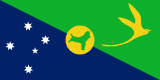
- description: territorial flag; divided diagonally from upper left to lower right; the upper triangle is green with a yellow silhouette of the golden bosun bird; the lower triangle is blue and shows the Southern Cross constellation, representing Australia; a centered yellow disk displays a green outline of the island
Capital
- Name
- The Settlement (Flying Fish Cove)
- Etymology
- Flying Fish Cove was named after a British explorer's ship in 1886
- Time difference
- UTC+7 (12 hours ahead of Washington, DC, during Standard Time)
- Geographic coordinates
- 10 25 S, 105 43 E
- Suffrage
- 18 years of age
- Citizenship
- see Australia
Constitution
- History
- 1 October 1958 (Christmas Island Act 1958)
Country Name
- Etymology
- named by English Captain William MYNORS for the day of its rediscovery, Christmas Day (25 December 1643); Europeans had sighted the island as early as 1615
- Conventional long form
- Territory of Christmas Island
- Conventional short form
- Christmas Island
- Independence
- none (territory of Australia)
- Legal system
- system is under the authority of the governor general of Australia and Australian law
- Government type
- non-self-governing overseas territory of Australia
Judicial Branch
- Highest court(s)
- under the terms of the Territorial Law Reform Act 1992, Western Australia provides court services as needed for the island, including the Supreme Court and subordinate courts (District Court, Magistrate Court, Family Court, Children's Court, and Coroners' Court)
Executive Branch
- Cabinet
- NA
- Chief of state
- King CHARLES III (since 8 September 2022); represented by Governor-General of the Commonwealth of Australia General Sam MOSTYN (since 1 July 2024)
- Head of government
- Administrator Farzian ZAINAL (since 11 May 2023)
- Election/appointment process
- the monarchy is hereditary; governor general appointed by the monarch on the recommendation of the Australian prime minister; administrator appointed by the governor-general of Australia for a 2-year term and represents the monarch and Australia
- National holiday
- Australia Day (commemorates the arrival of the First Fleet of Australian settlers), 26 January (1788)
- Dependency status
- non-self-governing territory of Australia; administered from Canberra by the Department of Infrastructure, Transport, Cities & Regional Development
- Political parties
- none
Legislative Branch
- Term in office
- 4 years
- Number of seats
- 9 (directly elected)
- Electoral system
- plurality/majority
- Legislature name
- Christmas Island Shire Council
- Scope of elections
- partial renewal
- Legislative structure
- unicameral
- Most recent election date
- 10/2023
- Expected date of next election
- October 2025
- Percentage of women in chamber
- 13%
- Parties elected and seats per party
- independent (9)
National Anthem(s)
- Title
- "God Save the King"
- History
- royal anthem, as an Australian territory
- Lyrics/music
- unknown
- National symbol(s)
- golden bosun bird
- Diplomatic representation in the US
- none (territory of Australia)
Diplomatic Representation from the US
- Embassy
- none (territory of Australia)
- International organisations
- none
Economy
- Industries
- tourism, phosphate extraction (near depletion)
Exchange Rates
- Currency
- Australian dollars (AUD) per US dollar -
- Exchange rates 2020
- 1.453 (2020 est.)
- Exchange rates 2021
- 1.331 (2021 est.)
- Exchange rates 2022
- 1.442 (2022 est.)
- Exchange rates 2023
- 1.505 (2023 est.)
- Exchange rates 2024
- 1.515 (2024 est.)
- Economic overview
- high-income Australian territorial economy; development through government services and phosphate mining; operates Australia’s Immigration Detention Centre; increasing tourism and government investments; sustained environmental protections
- Exports partners
- Indonesia 30%, USA 26%, Malaysia 12%, Ireland 8%, UK 7% (2023)
- Imports partners
- USA 58%, Australia 40%, Malaysia 1%, Fiji 0%, Singapore 0% (2023)
- Exports commodities
- fertilizers, paintings, amine compounds (2023)
- Imports commodities
- aircraft, refined petroleum, cars, air conditioners, plastic products (2023)
Communications
Internet Users
- Percent of population
- 78.6% (2016 est.)
- Broadcast media
- 1 community radio station; satellite broadcasts of several Australian radio and TV stations (2017)
- Internet country code
- .cx
Transport
Ports
- Large
- 0
- Small
- 0
- Medium
- 1
- Key ports
- Flying Fish Cove
- Very small
- 0
- Total ports
- 1 (2024)
- Ports with oil terminals
- 0
- Airports
- 1 (2025)
Railways
- Note
- note: the 18-km Christmas Island Phosphate Company Railway between Flying Fish Cove and South Point was decommissioned in 1987; some tracks and scrap remain in place
- Total
- 18 km (2017)
- Standard gauge
- 18 km (2017) 1.435-m (not in operation)
Environment
- Climate
- tropical with a wet season (December to April) and dry season; heat and humidity moderated by trade winds
Land Use
- Other
- 100% (2018 est.)
- Agricultural land
- 0% (2018 est.)
- Environmental issues
- loss of rainforest; impact of phosphate mining
Military & Security
- Military note
- defense is the responsibility of Australia
Cite this page
Cite this page
Civica. (2026). Civica Atlas — Christmas Island — vintage 2026-Q1: Christmas Island factbook. Civica Atlas. Retrieved May 7, 2026, from https://civicaatlas.org/factbook/christmas-island
Sources: CIA World Factbook