Burkina Faso
 Burkina Faso
⌘K
Overview
- Background
- Many of Burkina Faso’s ethnic groups arrived in the region between the 12th and 15th centuries. The Gurma and Mossi peoples established several of the largest kingdoms in the area and used horse-mounted warriors in military campaigns. Of the various Mossi kingdoms, the most powerful were Ouagadougou and Yatenga. In the late 19th century, European states competed for control of the region. France eventually conquered the area and established it as a French protectorate.
The country achieved independence from France in 1960 and changed its name to Burkina Faso in 1984. Repeated military coups were common in the country’s first few decades. In 1987 Blaise COMPAORE deposed the president, established a government, and ruled for 27 years. In 2014, COMPAORE resigned after protests against his repeated efforts to amend the constitution's two-term presidential limit. An interim administration led a year-long transition, organizing presidential and legislative elections. In 2015, Roch Marc Christian KABORE was elected president, and he was reelected in 2020. In 2022, the military conducted two takeovers: In January, army colonel Paul Henri DAMIBA overthrew KABORE in a coup d'etat, and then in September, army captain Ibrahim TRAORE deposed DAMIBA and declared himself transition president. The transition government planned to hold elections by July 2024, but they may be delayed due to security concerns.
Terrorist groups -- including groups affiliated with Al-Qa’ida and the Islamic State -- began attacks in the country in 2016 and conducted attacks in the capital in 2016, 2017, and 2018. By early 2023, insecurity in Burkina Faso had displaced more than 2 million people and led to significant jumps in humanitarian needs and food insecurity. In addition to terrorism, the country faces a myriad of problems including high population growth, recurring drought, pervasive and perennial food insecurity, and limited natural resources. It is one of the world’s poorest countries.
Geography
Area
- Land
- 273,800 sq km
- Water
- 400 sq km
- Total
- 274,200 sq km
- Climate
- three climate zones including a hot tropical savanna with a short rainy season in the southern half, a tropical hot semi-arid steppe climate typical of the Sahel region in the northern half, and small area of hot desert in the very north of the country bordering the Sahara Desert
- Terrain
- mostly flat to dissected, undulating plains; hills in the west and southeast; occupies an extensive plateau with savanna that is grassy in the north and gradually gives way to sparse forests in the south
Land Use
- Other
- 33.9% (2023 est.)
- Forest
- 12.7% (2023 est.)
- Agricultural land
- 53.4% (2023 est.)
- Agricultural land: arable land
- arable land: 28.9% (2023 est.)
- Agricultural land: permanent crops
- permanent crops: 2.6% (2023 est.)
- Agricultural land: permanent pasture
- permanent pasture: 21.9% (2023 est.)
- Location
- Western Africa, north of Ghana
- Coastline
- 0 km (landlocked)
Elevation
- Lowest point
- Mouhoun (Black Volta) River 200 m
- Highest point
- Tena Kourou 749 m
- Mean elevation
- 297 m
- Irrigated land
- 550 sq km (2016)
- Map references
- Africa
Land Boundaries
- Total
- 3,611 km
- Border countries
- Benin 386 km; Cote d'Ivoire 545 km; Ghana 602 km; Mali 1325 km; Niger 622 km; Togo 131 km
- Maritime claims
- none (landlocked)
- Natural hazards
- recurring droughts
- Geography note
- landlocked savanna cut by the three principal rivers, the Black, Red, and White Voltas
- Natural resources
- gold, manganese, zinc, limestone, marble, phosphates, pumice, salt
- Area comparative
- slightly larger than Colorado
- Geographic coordinates
- 13 00 N, 2 00 W
- Population distribution
- most of the population is located in the center and south; nearly one third lives in cities, including the capital city of Ouagadougou (Ouaga), as shown in this population distribution map (2019)
Major Watersheds (Area Sq Km)
- Atlantic ocean drainage
- Niger (2,261,741 sq km), Volta (410,991 sq km)
- Major rivers (BY length in km)
- Volta river source (shared with Ghana [m]) - 1,600 km
note: [s] after country name indicates river source; [m] after country name indicates river mouth
People & Society
Literacy
- Male
- 48.4% (2023 est.)
- Female
- 35.7% (2023 est.)
- Total population
- 41.4% (2023 est.)
- Languages
- Mossi 52.9%, Fula 7.8%, Gourmantche 6.8%, Dyula 5.7%, Bissa 3.3%, Gurunsi 3.2%, French (official) 2.2%, Bwamu 2%, Dagara 2%, San 1.7%, Marka 1.6%, Bobo 1.5%, Senufo 1.5%, Lobi 1.2%, other 6.6% (2019 est.)
- Religions
- Muslim 63.8%, Roman Catholic 20.1%, Animiste 9%, Protestant 6.2%, other 0.2%, none 0.7% (2019 est.)
Sex Ratio
- At birth
- 1.03 male(s)/female
- 0 14 years
- 1.03 male(s)/female
- 15 64 years
- 0.93 male(s)/female
- Total population
- 0.96 male(s)/female (2024 est.)
- 65 years and over
- 0.73 male(s)/female
- Birth rate
- 31.74 births/1,000 population (2025 est.)
- Death rate
- 7.24 deaths/1,000 population (2025 est.)
Median Age
- Male
- 17.9 years
- Total
- 19 years (2025 est.)
- Female
- 19.5 years
Population
- Male
- 11,529,979
- Total
- 23,490,300 (2025 est.)
- Female
- 11,960,321
Nationality
- Noun
- Burkinabe (singular and plural)
- Adjective
- Burkinabe
Tobacco Use
- Male
- 20.4% (2025 est.)
- Total
- 12.4% (2025 est.)
- Female
- 4.6% (2025 est.)
Urbanization
- Urban population
- 32.5% of total population (2023)
- Rate of urbanization
- 4.75% annual rate of change (2020-25 est.)
Age Structure
- 0 14 years
- 41.6% (male 4,868,488/female 4,727,316)
- 15 64 years
- 55.1% (male 6,116,674/female 6,590,775)
- 65 years and over
- 3.2% (2024 est.) (male 312,587/female 426,359)
- Ethnic groups
- Mossi 53.7%, Fulani (Peuhl) 6.8%, Gurunsi 5.9%, Bissa 5.4%, Gurma 5.2%, Bobo 3.4%, Senufo 2.2%, Bissa 1.5%, Lobi 1.5%, Tuareg/Bella 0.1%, other 12.8%, foreign 0.7% (2021 est.)
Child Marriage
- Men married BY age 18
- 1.6% (2015)
- Women married BY age 15
- 8.9% (2015)
- Women married BY age 18
- 51.3% (2015)
Dependency Ratios
- Total dependency ratio
- 79 (2025 est.)
- Youth dependency ratio
- 73.2 (2025 est.)
- Potential support ratio
- 17.3 (2025 est.)
- Elderly dependency ratio
- 5.8 (2025 est.)
- Physician density
- 0.15 physicians/1,000 population (2022)
Health Expenditure
- Health expenditure (as % of GDP)
- 6.4% of GDP (2021)
- Health expenditure (as % of national budget)
- 8.4% of national budget (2022 est.)
- Net migration rate
- -0.57 migrant(s)/1,000 population (2025 est.)
- Hospital bed density
- 0.2 beds/1,000 population (2020 est.)
- Total fertility rate
- 4.02 children born/woman (2025 est.)
Drinking Water Source
- Improved: rural
- rural: 34.8% of population (2022 est.)
- Improved: total
- total: 49.5% of population (2022 est.)
- Improved: urban
- urban: 80.9% of population (2022 est.)
- Unimproved: rural
- rural: 65.2% of population (2022 est.)
- Unimproved: total
- total: 50.5% of population (2022 est.)
- Unimproved: urban
- urban: 19.1% of population (2022 est.)
Education Expenditure
- Education expenditure (% GDP)
- 5.3% of GDP (2023 est.)
- Education expenditure (% national budget)
- 20.3% national budget (2023 est.)
Infant Mortality Rate
- Male
- 51.1 deaths/1,000 live births
- Total
- 48 deaths/1,000 live births (2025 est.)
- Female
- 42.7 deaths/1,000 live births
- Population growth rate
- 2.39% (2025 est.)
- Gross reproduction rate
- 1.98 (2025 est.)
- Population distribution
- most of the population is located in the center and south; nearly one third lives in cities, including the capital city of Ouagadougou (Ouaga), as shown in this population distribution map (2019)
Life Expectancy at Birth
- Male
- 62.3 years
- Female
- 66.1 years
- Total population
- 64.2 years (2024 est.)
- Maternal mortality ratio
- 242 deaths/100,000 live births (2023 est.)
Sanitation Facility Access
- Improved: rural
- rural: 42.6% of population (2022 est.)
- Improved: total
- total: 58.1% of population (2022 est.)
- Improved: urban
- urban: 91.2% of population (2022 est.)
- Unimproved: rural
- rural: 57.4% of population (2022 est.)
- Unimproved: total
- total: 41.9% of population (2022 est.)
- Unimproved: urban
- urban: 8.8% of population (2022 est.)
Alcohol Consumption Per Capita
- Beer
- 1 liters of pure alcohol (2019 est.)
- Wine
- 0.08 liters of pure alcohol (2019 est.)
- Total
- 7.28 liters of pure alcohol (2019 est.)
- Spirits
- 0.31 liters of pure alcohol (2019 est.)
- Other alcohols
- 5.88 liters of pure alcohol (2019 est.)
- Major urban areas population
- 3.204 million OUAGADOUGOU (capital), 1.129 million Bobo-Dioulasso (2023)
- Obesity adult prevalence rate
- 5.6% (2016)
- Mother's mean age at first birth
- 20.1 years (2021 est.)
- Currently married women (ages 15 49)
- 74.3% (2021 est.)
- Children under the age of 5 years underweight
- 16.9% (2021 est.)
School Life Expectancy (Primary to Tertiary Education)
- Male
- 7 years (2023 est.)
- Total
- 7 years (2023 est.)
- Female
- 7 years (2023 est.)
Government
Civica · structure
How power is organised
ExecutiveLegislative
- Flag
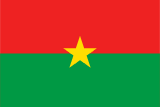
- description: two equal horizontal bands of red (top) and green, with a five-pointed yellow star in the center
meaning: red stands for the country's struggle for independence, green for hope and abundance, and yellow for the country's mineral wealth
history: uses the colors of the Pan-African movement
Capital
- Name
- Ouagadougou
- Etymology
- Ouagadougou is a Francophone spelling of the native name "Wogodogo," which may come from the personal name "Waga" or "Woga" and the Dyula word "dugu," meaning "village"
- Time difference
- UTC 0 (5 hours ahead of Washington, DC, during Standard Time)
- Geographic coordinates
- 12 22 N, 1 31 W
- Suffrage
- 18 years of age; universal
Citizenship
- Citizenship BY birth
- no
- Citizenship BY descent only
- at least one parent must be a citizen of Burkina Faso
- Dual citizenship recognized
- yes
- Residency requirement for naturalization
- 10 years
Constitution
- History
- several previous; latest approved by referendum 2 June 1991, adopted 11 June 1991, temporarily suspended late October to mid-November 2014; initial draft of a new constitution to usher in the new republic was completed in January 2017 and a final draft was submitted to the government in December 2017; a constitutional referendum originally scheduled for adoption in March 2019 was postponed; on 1 March 2022 a transition charter was adopted, allowing military authorities to rule for three years and barring the transitional president from being an electoral candidate after the transition
- Amendment process
- proposed by the president, by a majority of National Assembly membership, or by petition of at least 30,000 eligible voters submitted to the Assembly; passage requires at least three-fourths majority vote in the Assembly; failure to meet that threshold requires majority voter approval in a referendum; constitutional provisions on the form of government, the multiparty system, and national sovereignty cannot be amended
Country Name
- Former
- Upper Volta, Republic of Upper Volta
- Etymology
- name translates as "Land of the Worthy Men," from the Dyula words burkina, or "worthy," and faso, which means "land" or literally "father village," from fa, or "father," and so, or "village"
- Local long form
- none
- Local short form
- Burkina Faso
- Conventional long form
- none
- Conventional short form
- Burkina Faso
- Independence
- 5 August 1960 (from France)
- Legal system
- civil law based on the French model and customary law
- Government type
- presidential republic
Judicial Branch
- Highest court(s)
- Supreme Court of Appeals or Cour de Cassation (consists of NA judges); Council of State (consists of NA judges); Constitutional Council or Conseil Constitutionnel (consists of the council president and 9 members)
- Subordinate courts
- Appeals Court; High Court; first instance tribunals; district courts; specialized courts relating to issues of labor, children, and juveniles; village (customary) courts
- Judge selection and term of office
- Supreme Court judge appointments mostly controlled by the president of Burkina Faso; judges have no term limits; Council of State judge appointment and tenure NA; Constitutional Council judges appointed by the president of Burkina Faso after a proposal from the minister of justice and the president of the National Assembly; judges appointed for 9-year terms with one-third of membership renewed every 3 years
Executive Branch
- Note
- note: on 30 September 2022, a military junta led by TRAORE took power and ousted Transition President Lt. Col. Paul-Henri Sandaogo DAMIBA
- Cabinet
- prior to the 2022 coups and ad hoc suspension of laws and constitutional provisions, Council of Ministers appointed by the president on the recommendation of the prime minister
- Chief of state
- Transitional President Capt. Ibrahim TRAORE (since 30 September 2022)
- Election results
2020: Roch Marc Christian KABORE reelected president in first round; percent of vote - Roch Marc Christian KABORE (MPP) 57.9%, Eddie KOMBOIGO (CDP) 15.5%, Zephirin DIABRE (UPC) 12.5%, other 14.1%- Head of government
- Prime Minister Rimtalba Jean Emmanuel OUEDRAOGO (since 9 December 2024)
- Most recent election date
- 22 November 2020
- Election/appointment process
- prior to the 2022 coups and ad hoc suspension of laws and constitutional provisions, president directly elected by absolute-majority popular vote in 2 rounds, if needed, for a 5-year term (eligible for a second term); prime minister appointed by the president with consent of the National Assembly
- Expected date of next election
- were to be held by July 2024, but were delayed
- National holiday
- Republic Day, 11 December (1958)
- National color(s)
- red, yellow, green
National Heritage
- Total world heritage sites
- 4 (3 cultural, 1 natural)
- Selected world heritage site locales
- Ruins of Loropéni (c); Ancient Ferrous Metallurgy Sites of Burkina Faso (c); W-Arly-Pendjari Complex (n); Royal Court of Tiébélé (c)
- Political parties
- Act Together
African Democratic Rally/Alliance for Democracy and Federation or ADF/RDA
Congress for Democracy and Progress or CDP
Convergence for Progress and Solidarity-Generation 3 or CPS-G3
Movement for the Future Burkina Faso or MBF
National Convention for Progress or CNP
New Era for Democracy or NTD
Pan-African Alliance for Refoundation or APR
Party for Democracy and Socialism/Metba or PDS/Metba
Party for Development and Change or PDC
Patriotic Rally for Integrity or RPI
Peoples Movement for Progress or MPP
Progressives United for Renewal or PUR
Union for Progress and Reform or UPC
Union for Rebirth - Sankarist Party or UNIR-PS
Legislative Branch
- Note
- note: a series of coups in 2022 led to the ad hoc suspension of laws and constitutional provisions, including the unicameral National Assembly; a military junta in 2022 appointed the 71-member Transnational Legislative Assembly (ALT); a Transitional Charter, adopted in October 2022, provided for a transitional period that was extended in May 2024 until July 2029
- Chamber name
- Transitional Legislative Assembly (Assemblée législative de la transition)
- Number of seats
- 71
- Electoral system
- proportional representation
- Legislature name
- Parliament (Parlement)
- Legislative structure
- unicameral
- Most recent election date
- 11/11/2022
- Expected date of next election
- June 2029
- Percentage of women in chamber
- 18.3%
National Anthem(s)
- Title
- "Le Ditanye" (Anthem of Victory)
- History
- adopted 1974; also known as "Une Seule Nuit"(One Single Night) ; written by the country's former president, an avid guitar player
- Lyrics/music
- Thomas SANKARA
- National symbol(s)
- white stallion
- Administrative divisions
- 13 regions; Boucle du Mouhoun, Cascades, Centre, Centre-Est, Centre-Nord, Centre-Ouest, Centre-Sud, Est, Hauts-Bassins, Nord, Plateau-Central, Sahel, Sud-Ouest
Diplomatic Representation in the US
- Fax
- [1] (202) 667-1882
- Chancery
- 2340 Massachusetts Avenue NW, Washington, DC 20008
- Telephone
- [1] (202) 332-5577
- Chief of mission
- Ambassador Kassoum COULIBALY (since 24 July 2025)
- Email address and website
contact@burkina-usa.org
https://burkina-usa.org/
Diplomatic Representation from the US
- Fax
- (226) 25-49-56-23
- Embassy
- Secteur 15, Ouaga 2000, Avenue Sembene Ousmane, Rue 15.873, Ouagadougou
- Telephone
- (226) 25-49-53-00
- Mailing address
- 2440 Ouagadougou Place, Washington, DC 20521-2440
- Chief of mission
- Ambassador Joann M. LOCKARD (since 28 June 2024)
- Email address and website
AmembOuaga@state.gov
https://bf.usembassy.gov/
- International organisations
- ACP, AfDB, AU (suspended), CD, EITI (compliant country), Entente, FAO, FZ, G-77, IAEA, IBRD, ICAO, ICC (NGOs), ICCt, ICRM, IDA, IDB, IFAD, IFC, IFRCS, ILO, IMF, Interpol, IOC, IOM, IPU, ISO, ITSO, ITU, ITUC (NGOs), MIGA, MINUSCA, MONUSCO, NAM, OIC, OIF, OPCW, PCA, UN, UNCTAD, UNESCO, UNIDO, UNISFA, UNITAR, UNMISS, UNOOSA, UNWTO, UPU, WADB (regional), WAEMU, WCO, WFTU (NGOs), WHO, WIPO, WMO, WTO
- International law organization participation
- has not submitted an ICJ jurisdiction declaration; accepts ICCt jurisdiction
Legislature
BURKINA FASO · LEGISLATURE
Transitional Legislative Assembly
71 seats · hover a seat for the party
Total seats
71
Majority line
37
Largest party
Congress for Democracy and Progress
Parties
9
All political parties
Leaders
Current
Ibrahim Traoré
- Head of State
Apollinaire Joachim Kyélem de Tambèla
- Head of Government
Economy
Budget
- Note
- note: central government revenues (excluding grants) and expenditures converted to US dollars at average official exchange rate for year indicated
- Revenues
- $5.174 billion (2023 est.)
- Expenditures
- $6.308 billion (2023 est.)
Exports
- Civica canonical (reconciled)
- $6.6B
- Note
- note: balance of payments - exports of goods and services in current dollars
- Exports 2021
- $6.234 billion (2021 est.)
- Exports 2022
- $5.814 billion (2022 est.)
- Exports 2023
- $5.912 billion (2023 est.)
Imports
- Civica canonical (reconciled)
- $7.4B
- Note
- note: balance of payments - imports of goods and services in current dollars
- Imports 2021
- $5.835 billion (2021 est.)
- Imports 2022
- $6.761 billion (2022 est.)
- Imports 2023
- $6.834 billion (2023 est.)
- Industries
- cotton lint, beverages, agricultural processing, soap, cigarettes, textiles, gold
- Labor force
- 6.461 million (2024 est.)
Public Debt
- Civica canonical (reconciled)
- 61.9%
- Note
- note: central government debt as a % of GDP
- Public debt 2023
- 61.3% of GDP (2023 est.)
Remittances
- Note
- note: personal transfers and compensation between resident and non-resident individuals/households/entities
- Remittances 2021
- 2.9% of GDP (2021 est.)
- Remittances 2022
- 2.8% of GDP (2022 est.)
- Remittances 2023
- 2.9% of GDP (2023 est.)
Exchange Rates
- Currency
- Communaute Financiere Africaine francs (XOF) per US dollar -
- Exchange rates 2020
- 575.586 (2020 est.)
- Exchange rates 2021
- 554.531 (2021 est.)
- Exchange rates 2022
- 623.76 (2022 est.)
- Exchange rates 2023
- 606.57 (2023 est.)
- Exchange rates 2024
- 606.345 (2024 est.)
Debt External
- Note
- note: present value of external debt in current US dollars
- Debt external 2023
- $3.565 billion (2023 est.)
- Economic overview
- highly agrarian, low-income economy; limited natural resources; widespread poverty; terrorism disrupting potential economic activity; improving trade balance via increases in gold exports; economy inflating after prior deflation; growing public debt but still manageable
Unemployment Rate
- Civica canonical (reconciled)
- 3.5%
- Note
- note: % of labor force seeking employment
- Unemployment rate 2022
- 5.4% (2022 est.)
- Unemployment rate 2023
- 5.4% (2023 est.)
- Unemployment rate 2024
- 5.2% (2024 est.)
- Exports partners
- Switzerland 72%, UAE 10%, India 3%, Mali 3%, Cote d'Ivoire 2% (2023)
- Imports partners
- Cote d'Ivoire 14%, China 13%, Ghana 9%, Russia 9%, France 7% (2023)
Real GDP Per Capita
- Civica canonical (reconciled)
- $2,896
- Note
- note: data in 2021 dollars
- Real GDP per capita 2022
- $2,500 (2022 est.)
- Real GDP per capita 2023
- $2,500 (2023 est.)
- Real GDP per capita 2024
- $2,500 (2024 est.)
Real GDP Growth Rate
- Civica canonical (reconciled)
- 4.8%
- Note
- note: annual GDP % growth based on constant local currency
- Real GDP growth rate 2022
- 1.5% (2022 est.)
- Real GDP growth rate 2023
- 3% (2023 est.)
- Real GDP growth rate 2024
- 5% (2024 est.)
- Agricultural products
- maize, sorghum, fruits, vegetables, millet, cowpeas, cotton, groundnuts, sugarcane, rice (2023)
- Exports commodities
- gold, cotton, oil seeds, coconuts/brazil nuts/cashews, cement (2023)
- Imports commodities
- refined petroleum, plastic products, cement, electricity, packaged medicine (2023)
Current Account Balance
- Civica canonical (reconciled)
- -$1.0B
- Note
- note: balance of payments - net trade and primary/secondary income in current dollars
- Current account balance 2021
- $77.255 million (2021 est.)
- Current account balance 2022
- -$1.404 billion (2022 est.)
- Current account balance 2023
- -$1.017 billion (2023 est.)
- Taxes and other revenues
- 18.4% (of GDP) (2023 est.)
- GDP (official exchange rate)
- $23.25 billion (2024 est.)
GDP Composition, BY End Use
- Note
- note: figures may not total 100% due to rounding or gaps in data collection
- Household consumption
- 60.6% (2024 est.)
- Government consumption
- 18.8% (2024 est.)
- Investment in inventories
- 10.6% (2024 est.)
- Investment in fixed capital
- 16.5% (2024 est.)
- Exports of goods and services
- 28.5% (2024 est.)
- Imports of goods and services
- -34.9% (2024 est.)
- Population below poverty line
- 43.2% (2021 est.)
Inflation Rate (Consumer Prices)
- Civica canonical (reconciled)
- 4.2%
- Note
- note: annual % change based on consumer prices
- Inflation rate (consumer prices) 2022
- 14.3% (2022 est.)
- Inflation rate (consumer prices) 2023
- 0.7% (2023 est.)
- Inflation rate (consumer prices) 2024
- 4.2% (2024 est.)
- Industrial production growth rate
- -5.4% (2024 est.)
Real GDP (Purchasing Power Parity)
- Civica canonical (reconciled)
- $60.001 billion (2024 est.)
- Note
- note: data in 2021 dollars
- Real GDP (purchasing power parity) 2022
- $55.508 billion (2022 est.)
- Real GDP (purchasing power parity) 2023
- $57.152 billion (2023 est.)
- Real GDP (purchasing power parity) 2024
- $60.001 billion (2024 est.)
Youth Unemployment Rate (Ages 15 24)
- Male
- 7.8% (2024 est.)
- Note
- note: % of labor force ages 15-24 seeking employment
- Total
- 8.1% (2024 est.)
- Female
- 8.5% (2024 est.)
GDP Composition, BY Sector of Origin
- Note
- note: figures may not total 100% due to non-allocated consumption not captured in sector-reported data
- Industry
- 29.7% (2024 est.)
- Services
- 40.2% (2024 est.)
- Agriculture
- 18.6% (2024 est.)
Household Income or Consumption BY Percentage Share
- Note
- note: % share of income accruing to lowest and highest 10% of population
- Lowest 10%
- 3% (2021 est.)
- Highest 10%
- 30.2% (2021 est.)
Gini Index Coefficient Distribution of Family Income
- Note
- note: index (0-100) of income distribution; higher values represent greater inequality
- Gini index coefficient distribution of family income 2021
- 37.4 (2021 est.)
Energy
Coal
- Exports
- 1 metric tons (2023 est.)
- Imports
- 74 metric tons (2023 est.)
Petroleum
- Refined petroleum consumption
- 37,000 bbl/day (2023 est.)
Electricity
- Imports
- 1.577 billion kWh (2023 est.)
- Consumption
- 3.096 billion kWh (2023 est.)
- Installed generating capacity
- 749,000 kW (2023 est.)
- Transmission/distribution losses
- 212.254 million kWh (2023 est.)
Electricity Access
- Electrification rural areas
- 3.4%
- Electrification urban areas
- 60.5%
- Electrification total population
- 19.5% (2022 est.)
Energy Consumption Per Capita
- Total energy consumption per capita 2023
- 3.481 million Btu/person (2023 est.)
Electricity Generation Sources
- Solar
- 5.4% of total installed capacity (2023 est.)
- Fossil fuels
- 82.9% of total installed capacity (2023 est.)
- Hydroelectricity
- 6.7% of total installed capacity (2023 est.)
- Biomass and waste
- 5.1% of total installed capacity (2023 est.)
Communications
Internet Users
- Percent of population
- 17% (2023 est.)
- Broadcast media
- 14 digital TV channels, of which 2 are state-owned; over 140 national radio stations (commercial, religious, community), including a national and regional state-owned network; state-owned Radio Burkina and private Radio Omega are among the most widely available and broadcast in both French and local languages (2019)
- Internet country code
- .bf
Telephones Fixed Lines
- Total subscriptions
- 72,700 (2022 est.)
- Subscriptions per 100 inhabitants
- (2022 est.) less than 1
Telephones Mobile Cellular
- Total subscriptions
- 26.9 million (2022 est.)
- Subscriptions per 100 inhabitants
- 119 (2022 est.)
Broadband Fixed Subscriptions
- Total
- 15,000 (2022 est.)
- Subscriptions per 100 inhabitants
- (2022 est.) less than 1
Transport
- Airports
- 49 (2025)
Railways
- Note
- note: another 660 km of this railway extends into Cote d'Ivoire
- Total
- 622 km (2014)
- Narrow gauge
- 622 km (2014) 1.000-m gauge
- Civil aircraft registration country code prefix
- XT
Environment
- Climate
- three climate zones including a hot tropical savanna with a short rainy season in the southern half, a tropical hot semi-arid steppe climate typical of the Sahel region in the northern half, and small area of hot desert in the very north of the country bordering the Sahara Desert
Land Use
- Other
- 33.9% (2023 est.)
- Forest
- 12.7% (2023 est.)
- Agricultural land
- 53.4% (2023 est.)
- Agricultural land: arable land
- arable land: 28.9% (2023 est.)
- Agricultural land: permanent crops
- permanent crops: 2.6% (2023 est.)
- Agricultural land: permanent pasture
- permanent pasture: 21.9% (2023 est.)
Urbanization
- Urban population
- 32.5% of total population (2023)
- Rate of urbanization
- 4.75% annual rate of change (2020-25 est.)
Waste and Recycling
- Municipal solid waste generated annually
- 2.575 million tons (2024 est.)
- Percent of municipal solid waste recycled
- 23% (2022 est.)
- Environmental issues
- droughts; desertification; overgrazing; soil degradation; deforestation (2019)
Total Water Withdrawal
- Municipal
- 375.6 million cubic meters (2022 est.)
- Industrial
- 21.7 million cubic meters (2022 est.)
- Agricultural
- 420.7 million cubic meters (2022 est.)
Carbon Dioxide Emissions
- Total emissions
- 5.243 million metric tonnes of CO2 (2023 est.)
- From coal and metallurgical coke
- 7 metric tonnes of CO2 (2023 est.)
- From petroleum and other liquids
- 5.243 million metric tonnes of CO2 (2023 est.)
- Particulate matter emissions
- 38.5 micrograms per cubic meter (2019 est.)
- Total renewable water resources
- 13.5 billion cubic meters (2022 est.)
International Environmental Agreements
- Party to
- Biodiversity, Climate Change, Climate Change-Kyoto Protocol, Climate Change-Paris Agreement, Comprehensive Nuclear Test Ban, Desertification, Endangered Species, Hazardous Wastes, Law of the Sea, Marine Life Conservation, Ozone Layer Protection, Wetlands
- Signed, but not ratified
- Nuclear Test Ban
Military & Security
- Military note
- the Armed Forces of Burkina Faso (FABF) are responsible for external defense but also have an internal security role and can be called out to assist internal security forces in restoring public order, combating crime, securing the border, and conducting counterterrorism/counterinsurgency/internal defense operations; the FABF has a history of involvement in the country’s politics, having conducted eight coups since its formation in 1960-61, including the most recent in September 2022
the FABF's primary focus is combatting militants of the al-Qa'ida and Islamic State of Iraq and ash-Sham (ISIS) terrorist groups, which have operated in Burkina Faso for more than a decade and control portions of the country; Jama'at Nusrat al-Islam wal-Muslimin (JNIM), a coalition of al-Qa'ida linked militant groups that act as al-Qa'ida in the Land of the Islamic Magreb's (AQIM) arm in the Sahel, is strongest in the north but active in nearly all of the country's 13 provinces, while ISIS in the Greater Sahara (aka ISIS-Sahel) operates in the eastern part of the country (2025)
Military Expenditures
- Civica canonical (reconciled)
- 4.7%
- Military expenditures 2020
- 2.4% of GDP (2020 est.)
- Military expenditures 2021
- 2.4% of GDP (2021 est.)
- Military expenditures 2022
- 2.9% of GDP (2022 est.)
- Military expenditures 2023
- 4% of GDP (2023 est.)
- Military expenditures 2024
- 4.5% of GDP (2024 est.)
- Military and security forces
- Armed Forces of Burkina Faso (FABF; aka National Armed Forces (FAN), aka Defense and Security Forces (Forces de Défense et de Sécurité or FDS)): Army of Burkina Faso, Air Force of Burkina Faso, National Gendarmerie, National Fire Brigade (Brigade Nationale de Sapeurs-Pompiers or BNSP); Homeland Defense Volunteers (Forcés de Volontaires de Défense pour la Patrie or VDP)
Ministry of Territorial Administration, Decentralization and Security (Ministère de l'Administration Territoriale, de la Décentralisation et de la Sécurité): National Police of Burkina Faso (includes Border Police, Judicial Police, and Intervention Units, as well as State and Public Security forces) (2025) - Military service age and obligation
- generally, 18-35 years of age for voluntary military service for men and women; citizens 18-77 years of age are eligible to volunteer for the VDP (2025)
- Military equipment inventories and acquisitions
- the FABF has a mix of older and some modern armaments from a variety of suppliers, including China, Egypt, France, Russia, South Africa, Türkiye, the UK, and the UAE (2025)
- Military and security service personnel strengths
- estimated 20,000 Armed Forces; estimated 50,000 Homeland Defense Volunteers (2025)
Terrorism
- Terrorist group(s)
- Ansarul Islam; Islamic State of Iraq and ash-Sham in the Greater Sahara (ISIS-GS); al-Mulathamun Battalion (al-Mourabitoun); Jama'at Nusrat al-Islam wal-Muslimin (JNIM)
Transnational Issues
Trafficking in Persons
- Tier rating
- Tier 2 Watch List — the government did not demonstrate overall increasing efforts to eliminate trafficking compared with the previous reporting period, therefore Burkina Faso remained on Tier 2 Watch List for the second consecutive year; for more details, go to: https://www.state.gov/reports/2025-trafficking-in-persons-report/burkina-faso/
Refugees and Internally Displaced Persons
- Idps
- 2,065,358 (2024 est.)
- Refugees
- 41,408 (2024 est.)
Scores & Rankings
ScoreValueGlobal rankTrendAs of
Civica Index26.0 / 100as of 2024-Q4143 / 1902024-Q4
Civica Pulse−2.7as of 2026-05-06—2026-05-06
V-Dem Liberal Democracy0.13as of 2024-Q4127 / 1702024-Q4
Freedom House StatusNot Free (17/100)as of 2024-Q4—2024-Q4
Press Freedom (RSF)Partly free (50/100)as of 2024—2024
Human Development Index0.438as of 2022—2022
Cite this page
Cite this page
Civica. (2026). Civica Atlas — Burkina Faso — vintage 2026-Q1: Burkina Faso factbook. Civica Atlas. Retrieved May 7, 2026, from https://civicaatlas.org/factbook/burkina-faso
Sources: FAO FAOSTAT, ILO ILOSTAT, IMF (WEO), UN Statistics Division, UNDP HDR, UNESCO Institute for Statistics, V-Dem, WHO Global Health Observatory, World Bank, WTO Stats, CIA World Factbook, Wikidata