Botswana
 Botswana
⌘K
Overview
- Background
- In the early 1800s, multiple political entities in what is now Botswana were destabilized or destroyed by a series of conflicts and population movements in southern Africa. By the end of this period, the Tswana ethnic group, who also live across the border in South Africa, had become the most prominent group in the area. In 1852, Tswana forces halted the expansion of white Afrikaner settlers who were seeking to expand their territory northwards into what is now Botswana. In 1885, Great Britain claimed territory that roughly corresponds with modern day Botswana as a protectorate called Bechuanaland. Upon independence in 1966, the British protectorate of Bechuanaland adopted the new name of Botswana, which means "land of the Tswana."
More than five decades of uninterrupted civilian leadership, progressive social policies, and significant capital investment have created an enduring democracy and upper-middle-income economy. The ruling Botswana Democratic Party has won every national election since independence; President Mokgweetsi Eric Keabetswe MASISI assumed the presidency in 2018 after the retirement of former President Ian KHAMA due to constitutional term limits. MASISI won his first election as president in 2019, and he is Botswana’s fifth president since independence. Mineral extraction, principally diamond mining, dominates economic activity, though tourism is a growing sector due to the country's conservation practices and extensive nature preserves. Botswana has one of the world's highest rates of HIV/AIDS infection but also one of Africa's most progressive and comprehensive programs for dealing with the disease.
Geography
Area
- Land
- 566,730 sq km
- Water
- 15,000 sq km
- Total
- 581,730 sq km
- Climate
- semiarid; warm winters and hot summers
- Terrain
- predominantly flat to gently rolling tableland; Kalahari Desert in southwest
Land Use
- Other
- 26.6% (2023 est.)
- Forest
- 27.8% (2023 est.)
- Agricultural land
- 45.6% (2023 est.)
- Agricultural land: arable land
- arable land: 0.5% (2023 est.)
- Agricultural land: permanent crops
- permanent crops: 0% (2023 est.)
- Agricultural land: permanent pasture
- permanent pasture: 45.2% (2023 est.)
- Location
- Southern Africa, north of South Africa
- Coastline
- 0 km (landlocked)
Elevation
- Lowest point
- junction of the Limpopo and Shashe Rivers 513 m
- Highest point
- Manyelanong Hill 1,495 m
- Mean elevation
- 1,013 m
- Irrigated land
- 25 sq km (2014)
- Major aquifers
- Lower Kalahari-Stampriet Basin, Upper Kalahari-Cuvelai-Upper Zambezi Basin
- Map references
- Africa
Land Boundaries
- Total
- 4,347.15 km
- Border countries
- Namibia 1,544 km; South Africa 1,969 km; Zambia 0.15 km; Zimbabwe 834 km
- Maritime claims
- none (landlocked)
- Natural hazards
- periodic droughts; seasonal August winds blow from the west, carrying sand and dust across the country, which can obscure visibility
- Geography note
- landlocked; sparsely populated with most settlement concentrated in the southern and eastern parts of the country; geography dominated by the Kalahari Desert, which covers about 70% of the country, although the Okavango Delta brings considerable biodiversity as one of the largest inland deltas in the World
- Natural resources
- diamonds, copper, nickel, salt, soda ash, potash, coal, iron ore, silver
- Area comparative
- slightly smaller than Texas; almost four times the size of Illinois
- Geographic coordinates
- 22 00 S, 24 00 E
- Population distribution
- the population is primarily concentrated in the east, with a focus in and around the capital of Gaborone and the eastern city of Francistown; population density remains low in other areas in the country, especially in the Kalahari Desert to the west.
Major Watersheds (Area Sq Km)
- Indian ocean drainage
- Zambezi (1,332,412 sq km)
- Atlantic ocean drainage
- Orange (941,351 sq km)
- Internal (endorheic basin) drainage
- Okavango Basin (863,866 sq km)
- Major rivers (BY length in km)
- Zambezi (shared with Zambia [s]), Angola, Namibia, Zimbabwe, and Mozambique [m]) - 2,740 km; Limpopo (shared with South Africa [s], Zimbabwe, and Mozambique [m]) - 1,800 km; Okavango river mouth (shared with Angola [s], and Namibia) - 1,600 km
note: [s] after country name indicates river source; [m] after country name indicates river mouth
People & Society
- Languages
- Setswana 77.3%, Sekalanga 7.4%, Shekgalagadi 3.4%, English (official) 2.8%, Zezuru/Shona 2%, Sesarwa 1.7%, Sembukushu 1.6%, Ndebele 1%, other 2.8% (2011 est.)
- Religions
- Christian 79.1%, Badimo 4.1%, other 1.4% (includes Baha'i, Hindu, Muslim, Rastafarian), none 15.2%, unspecified 0.3% (2011 est.)
Sex Ratio
- At birth
- 1.03 male(s)/female
- 0 14 years
- 1.02 male(s)/female
- 15 64 years
- 0.91 male(s)/female
- Total population
- 0.92 male(s)/female (2024 est.)
- 65 years and over
- 0.66 male(s)/female
- Birth rate
- 21.16 births/1,000 population (2025 est.)
- Death rate
- 6.8 deaths/1,000 population (2025 est.)
Median Age
- Male
- 26 years
- Total
- 25.8 years (2025 est.)
- Female
- 28.3 years
Population
- Male
- 1,234,898
- Total
- 2,521,534 (2025 est.)
- Female
- 1,286,636
Nationality
- Noun
- Motswana (singular), Batswana (plural)
- Adjective
- Motswana (singular), Batswana (plural)
Tobacco Use
- Male
- 29.2% (2025 est.)
- Total
- 17.1% (2025 est.)
- Female
- 5.5% (2025 est.)
Urbanization
- Urban population
- 72.9% of total population (2023)
- Rate of urbanization
- 2.47% annual rate of change (2020-25 est.)
Age Structure
- 0 14 years
- 28.7% (male 355,583/female 348,863)
- 15 64 years
- 65.2% (male 759,210/female 837,752)
- 65 years and over
- 6.1% (2024 est.) (male 59,513/female 89,747)
- Ethnic groups
- Tswana (or Setswana) 79%, Kalanga 11%, Basarwa 3%, other, including Kgalagadi and people of European ancestry 7%
Dependency Ratios
- Total dependency ratio
- 60.9 (2025 est.)
- Youth dependency ratio
- 52.1 (2025 est.)
- Potential support ratio
- 11.4 (2025 est.)
- Elderly dependency ratio
- 8.8 (2025 est.)
- Physician density
- 0.38 physicians/1,000 population (2023)
Health Expenditure
- Health expenditure (as % of GDP)
- 6.3% of GDP (2021)
- Health expenditure (as % of national budget)
- 14.6% of national budget (2022 est.)
- Net migration rate
- -1.14 migrant(s)/1,000 population (2025 est.)
- Hospital bed density
- 2.2 beds/1,000 population (2021 est.)
- Total fertility rate
- 2.73 children born/woman (2025 est.)
Drinking Water Source
- Improved: rural
- rural: 79.6% of population (2022 est.)
- Improved: total
- total: 92.6% of population (2022 est.)
- Improved: urban
- urban: 97.5% of population (2022 est.)
- Unimproved: rural
- rural: 20.4% of population (2022 est.)
- Unimproved: total
- total: 7.4% of population (2022 est.)
- Unimproved: urban
- urban: 2.5% of population (2022 est.)
Education Expenditure
- Education expenditure (% GDP)
- 8.1% of GDP (2020 est.)
- Education expenditure (% national budget)
- 21.5% national budget (2020 est.)
Infant Mortality Rate
- Male
- 25.9 deaths/1,000 live births
- Total
- 27.8 deaths/1,000 live births (2025 est.)
- Female
- 21.4 deaths/1,000 live births
- Population growth rate
- 1.32% (2025 est.)
- Gross reproduction rate
- 1.34 (2025 est.)
- Population distribution
- the population is primarily concentrated in the east, with a focus in and around the capital of Gaborone and the eastern city of Francistown; population density remains low in other areas in the country, especially in the Kalahari Desert to the west.
Life Expectancy at Birth
- Male
- 64.4 years
- Female
- 68.6 years
- Total population
- 66.4 years (2024 est.)
- Maternal mortality ratio
- 155 deaths/100,000 live births (2023 est.)
Sanitation Facility Access
- Improved: rural
- rural: 63% of population (2022 est.)
- Improved: total
- total: 86% of population (2022 est.)
- Improved: urban
- urban: 94.9% of population (2022 est.)
- Unimproved: rural
- rural: 37% of population (2022 est.)
- Unimproved: total
- total: 14% of population (2022 est.)
- Unimproved: urban
- urban: 5.1% of population (2022 est.)
Alcohol Consumption Per Capita
- Beer
- 2.93 liters of pure alcohol (2019 est.)
- Wine
- 0.46 liters of pure alcohol (2019 est.)
- Total
- 5.98 liters of pure alcohol (2019 est.)
- Spirits
- 0.96 liters of pure alcohol (2019 est.)
- Other alcohols
- 1.64 liters of pure alcohol (2019 est.)
- Major urban areas population
- 269,000 GABORONE (capital) (2018)
- Obesity adult prevalence rate
- 18.9% (2016)
- Currently married women (ages 15 49)
- 41.5% (2017 est.)
School Life Expectancy (Primary to Tertiary Education)
- Male
- 12 years (2021 est.)
- Total
- 12 years (2021 est.)
- Female
- 13 years (2021 est.)
Government
Civica · structure
How power is organised
ExecutiveLegislative
- Flag
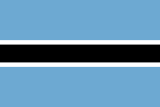
- description: light blue with a horizontal white-edged black stripe across the middle
meaning: the blue symbolizes rainwater, and the black and white bands represent racial harmony
Capital
- Name
- Gaborone
- Etymology
- named after GABORONE (ca. 1825-1931), a chief of the Tlokwa tribe, whose name means "it is not unbecoming"
- Time difference
- UTC+2 (7 hours ahead of Washington, DC, during Standard Time)
- Geographic coordinates
- 24 38 S, 25 54 E
- Suffrage
- 18 years of age; universal
Citizenship
- Citizenship BY birth
- no
- Citizenship BY descent only
- at least one parent must be a citizen of Botswana
- Dual citizenship recognized
- no
- Residency requirement for naturalization
- 10 years
Constitution
- History
- previous 1960 (pre-independence); latest adopted March 1965, effective 30 September 1966
- Amendment process
- proposed by the National Assembly; passage requires approval in two successive Assembly votes with at least two-thirds majority in the final vote; proposals to amend constitutional provisions on fundamental rights and freedoms, the structure and branches of government, and public services also requires approval by majority vote in a referendum and assent by the president of the republic
Country Name
- Former
- Bechuanaland
- Etymology
- the name Botswana means "Land of the Tswana," referring to the country's largest ethnic group
- Local long form
- Republic of Botswana
- Local short form
- Botswana
- Conventional long form
- Republic of Botswana
- Conventional short form
- Botswana
- Independence
- 30 September 1966 (from the UK)
- Legal system
- mixed legal system of civil law influenced by the Roman-Dutch model, including customary and common law
- Government type
- parliamentary republic
Judicial Branch
- Highest court(s)
- Court of Appeal, High Court (each consists of a chief justice and a number of other judges as prescribed by the Parliament)
- Subordinate courts
- Industrial Court (with circuits scheduled monthly in the capital city and in 3 districts); Magistrates Courts (1 in each district); Customary Court of Appeal; Paramount Chief's Court/Urban Customary Court; Senior Chief's Representative Court; Chief's Representative’s Court; Headman's Court
- Judge selection and term of office
- Court of Appeal and High Court chief justices appointed by the president and other judges appointed by the president upon the advice of the Judicial Service Commission; all judges appointed to serve until age 70
Executive Branch
- Cabinet
- Cabinet appointed by the president
- Chief of state
- President Duma BOKO (since 1 November 2024)
- Election results
- BOKO's UDC won 35 seats in the National Assembly, which then selected BOKO as president
- Head of government
- President Duma BOKO (since 1 November 2024)
- Most recent election date
- 31 October 2024
- Election/appointment process
- president indirectly elected by the National Assembly for a 5-year term (eligible for a second term); vice president appointed by the president
- Expected date of next election
- October 2029
- National holiday
- Independence Day (Botswana Day), 30 September (1966)
- National color(s)
- light blue, white, black
National Heritage
- Total world heritage sites
- 2 (1 cultural, 1 natural)
- Selected world heritage site locales
- Tsodilo Hills (c); Okavango Delta (n)
- Political parties
- Alliance of Progressives or AP
Botswana Congress Party or BCP
Botswana Democratic Party or BDP
Botswana National Front or BNF [Duma BOKO]Botswana Patriotic Front or BPF
Botswana Peoples Party or BPP
Botswana Republic Party or BRP
Umbrella for Democratic Change or UDC (various times the coalition has included the BPP, BCP, BNF and other parties)
Legislative Branch
- Note
- note: the House of Chiefs (Ntlo ya Dikgosi), an advisory body to the National Assembly, consists of 35 members -- 8 hereditary chiefs from Botswana's principal tribes, 22 indirectly elected by the chiefs, and 5 appointed by the president; the House of Chiefs consults on issues including powers of chiefs, customary courts, customary law, tribal property, and constitutional amendments
- Chamber name
- National Assembly
- Term in office
- 5 years
- Number of seats
- 69 (61 directly elected; 6 indirectly elected)
- Electoral system
- plurality/majority
- Legislature name
- Parliament
- Scope of elections
- full renewal
- Legislative structure
- unicameral
- Most recent election date
- 10/30/2024
- Expected date of next election
- October 2029
- Percentage of women in chamber
- 9%
- Parties elected and seats per party
- Umbrella for Democratic Change (UDC) (36); Botswana Congress Party (BCP) (15); Botswana Patriotic Front (BPF) (5); Botswana Democratic Party (BDP) (4); Other (1)
National Anthem(s)
- Title
- "Fatshe leno la rona" (Our Land)
- History
- adopted 1966
- Lyrics/music
- Kgalemang Tumedisco MOTSETE
- National symbol(s)
- zebra
- National coat of arms
- the two zebras, the country’s national symbol, support an elephant tusk that represents the country's fauna and a head of sorghum that signifies agriculture; the three wavy blue bands stand for the country’s reliance on water, the cog wheels for industry, and the bull’s head for the cattle industry; the coat of arms also features the national colors of light blue, white, and black; the motto reflects the scarcity of rain in the country: pula means “let there be rain” in Setswana, the national language
- Administrative divisions
- 10 districts and 6 town councils*; Central, Chobe, Francistown*, Gaborone*, Ghanzi, Jwaneng*, Kgalagadi, Kgatleng, Kweneng, Lobatse*, North East, North West, Selebi-Phikwe*, South East, Southern, Sowa Town*
Diplomatic Representation in the US
- Fax
- [1] (202) 244-4164
- Chancery
- 1531-1533 New Hampshire Avenue NW, Washington, DC 20036
- Telephone
- [1] (202) 244-4990
- Chief of mission
- Ambassador Mpho Churchill MOPHUTING (since 18 September 2024)
- Email address and website
info@botswanaembassy.org
http://www.botswanaembassy.org/
Diplomatic Representation from the US
- Fax
- [267] 318-0232
- Embassy
- Embassy Drive, Government Enclave (off Khama Crescent), Gaborone
- Telephone
- [267] 395-3982
- Mailing address
- 2170 Gaborone Place, Washington DC 20521-2170
- Chief of mission
- Ambassador Howard A. VAN VRANKEN (since 24 May 2023)
- Email address and website
ConsularGaborone@state.gov
https://bw.usembassy.gov/
- International organisations
- ACP, AfDB, AU, C, CD, FAO, G-77, IAEA, IBRD, ICAO, ICCt, ICRM, IDA, IFAD, IFC, IFRCS, ILO, IMF, Interpol, IOC, IOM, IPU, ISO, ITSO, ITU, ITUC (NGOs), MIGA, MONUSCO, NAM, OPCW, SACU, SADC, UN, UNCTAD, UNESCO, UNIDO, UNWTO, UPU, WCO, WFTU (NGOs), WHO, WIPO, WMO, WTO
- International law organization participation
- accepts compulsory ICJ jurisdiction with reservations; accepts ICCt jurisdiction
Legislature
BOTSWANA · LEGISLATURE
National Assembly
69 seats · hover a seat for the party
Total seats
69
Majority line
36
Largest party
Umbrella for Democratic Change (UDC)
Parties
5
All political parties
Leaders
Current
Duma Boko
- Head of State
Economy
Budget
- Note
- note: central government revenues and expenses (excluding grants/extrabudgetary units/social security funds) converted to US dollars at average official exchange rate for year indicated
- Revenues
- $5.474 billion (2024 est.)
- Expenditures
- $6.296 billion (2024 est.)
Exports
- Civica canonical (reconciled)
- $5.3B
- Note
- note: balance of payments - exports of goods and services in current dollars
- Exports 2021
- $7.861 billion (2021 est.)
- Exports 2022
- $8.914 billion (2022 est.)
- Exports 2023
- $6.398 billion (2023 est.)
Imports
- Civica canonical (reconciled)
- $8.5B
- Note
- note: balance of payments - imports of goods and services in current dollars
- Imports 2021
- $9.25 billion (2021 est.)
- Imports 2022
- $8.826 billion (2022 est.)
- Imports 2023
- $7.228 billion (2023 est.)
- Industries
- diamonds, copper, nickel, salt, soda ash, potash, coal, iron ore, silver; beef processing; textiles
- Labor force
- 1.173 million (2024 est.)
Public Debt
- Civica canonical (reconciled)
- 19.6%
- Note
- note: central government debt as a % of GDP
- Public debt 2020
- 19.6% of GDP (2020 est.)
Remittances
- Note
- note: personal transfers and compensation between resident and non-resident individuals/households/entities
- Remittances 2021
- 0.3% of GDP (2021 est.)
- Remittances 2022
- 0.3% of GDP (2022 est.)
- Remittances 2023
- 0.4% of GDP (2023 est.)
Exchange Rates
- Currency
- pulas (BWP) per US dollar -
- Exchange rates 2020
- 11.456 (2020 est.)
- Exchange rates 2021
- 11.087 (2021 est.)
- Exchange rates 2022
- 12.369 (2022 est.)
- Exchange rates 2023
- 13.596 (2023 est.)
- Exchange rates 2024
- 13.563 (2024 est.)
Debt External
- Note
- note: present value of external debt in current US dollars
- Debt external 2023
- $1.761 billion (2023 est.)
- Economic overview
- good economic governance and financial management; diamond-driven growth model declining; rapid poverty reductions; high unemployment, particularly among youth; COVID-19 sharply contracted the economy and recovery is slow; public sector wages have posed fiscal challenges
Unemployment Rate
- Civica canonical (reconciled)
- 24.5%
- Note
- note: % of labor force seeking employment
- Unemployment rate 2022
- 23.7% (2022 est.)
- Unemployment rate 2023
- 23.4% (2023 est.)
- Unemployment rate 2024
- 23.2% (2024 est.)
- Exports partners
- UAE 27%, India 17%, Belgium 16%, South Africa 8%, USA 7% (2023)
- Imports partners
- South Africa 65%, Namibia 8%, Canada 5%, China 3%, India 3% (2023)
Real GDP Per Capita
- Civica canonical (reconciled)
- $20,538
- Note
- note: data in 2021 dollars
- Real GDP per capita 2022
- $18,600 (2022 est.)
- Real GDP per capita 2023
- $18,900 (2023 est.)
- Real GDP per capita 2024
- $18,100 (2024 est.)
Real GDP Growth Rate
- Civica canonical (reconciled)
- -3.0%
- Note
- note: annual GDP % growth based on constant local currency
- Real GDP growth rate 2022
- 5.5% (2022 est.)
- Real GDP growth rate 2023
- 3.2% (2023 est.)
- Real GDP growth rate 2024
- -3% (2024 est.)
- Agricultural products
- root vegetables, beef, vegetables, sorghum, maize, game meat, milk, watermelons, goat milk, sunflower seeds (2023)
- Exports commodities
- diamonds, copper ore, insulated wire, carbonates, cattle (2023)
- Imports commodities
- refined petroleum, diamonds, cars, flavored water, electricity (2023)
Current Account Balance
- Civica canonical (reconciled)
- -$821.1M
- Note
- note: balance of payments - net trade and primary/secondary income in current dollars
- Current account balance 2021
- -$314.583 million (2021 est.)
- Current account balance 2022
- -$232.122 million (2022 est.)
- Current account balance 2023
- -$116.727 million (2023 est.)
- Taxes and other revenues
- 19.6% (of GDP) (2022 est.)
- GDP (official exchange rate)
- $19.401 billion (2024 est.)
GDP Composition, BY End Use
- Note
- note: figures may not total 100% due to rounding or gaps in data collection
- Household consumption
- 45.3% (2024 est.)
- Government consumption
- 32.1% (2024 est.)
- Investment in inventories
- 7.7% (2024 est.)
- Investment in fixed capital
- 28.5% (2024 est.)
- Exports of goods and services
- 26% (2024 est.)
- Imports of goods and services
- -40.9% (2024 est.)
- Population below poverty line
- 16.1% (2015 est.)
Inflation Rate (Consumer Prices)
- Civica canonical (reconciled)
- 2.8%
- Note
- note: annual % change based on consumer prices
- Inflation rate (consumer prices) 2022
- 11.7% (2022 est.)
- Inflation rate (consumer prices) 2023
- 5.1% (2023 est.)
- Inflation rate (consumer prices) 2024
- 2.8% (2024 est.)
- Industrial production growth rate
- -13.5% (2024 est.)
Real GDP (Purchasing Power Parity)
- Civica canonical (reconciled)
- $45.553 billion (2024 est.)
- Note
- note: data in 2021 dollars
- Real GDP (purchasing power parity) 2022
- $45.498 billion (2022 est.)
- Real GDP (purchasing power parity) 2023
- $46.957 billion (2023 est.)
- Real GDP (purchasing power parity) 2024
- $45.553 billion (2024 est.)
Youth Unemployment Rate (Ages 15 24)
- Male
- 39.8% (2024 est.)
- Note
- note: % of labor force ages 15-24 seeking employment
- Total
- 43.9% (2024 est.)
- Female
- 48.6% (2024 est.)
Reserves of Foreign Exchange and Gold
- Note
- note: holdings of gold (year-end prices)/foreign exchange/special drawing rights in current dollars
- Reserves of foreign exchange and gold 2022
- $4.279 billion (2022 est.)
- Reserves of foreign exchange and gold 2023
- $4.756 billion (2023 est.)
- Reserves of foreign exchange and gold 2024
- $3.456 billion (2024 est.)
GDP Composition, BY Sector of Origin
- Note
- note: figures may not total 100% due to non-allocated consumption not captured in sector-reported data
- Industry
- 29.4% (2024 est.)
- Services
- 63.5% (2024 est.)
- Agriculture
- 1.7% (2024 est.)
Household Income or Consumption BY Percentage Share
- Note
- note: % share of income accruing to lowest and highest 10% of population
- Lowest 10%
- 1.4% (2015 est.)
- Highest 10%
- 42.9% (2015 est.)
Gini Index Coefficient Distribution of Family Income
- Note
- note: index (0-100) of income distribution; higher values represent greater inequality
- Gini index coefficient distribution of family income 2015
- 54.9 (2015 est.)
Energy
Coal
- Exports
- 891,000 metric tons (2023 est.)
- Imports
- 300 metric tons (2023 est.)
- Production
- 2.242 million metric tons (2023 est.)
- Consumption
- 1.351 million metric tons (2023 est.)
- Proven reserves
- 1.66 billion metric tons (2023 est.)
Petroleum
- Refined petroleum consumption
- 22,000 bbl/day (2023 est.)
Electricity
- Exports
- 2 million kWh (2023 est.)
- Imports
- 1.923 billion kWh (2023 est.)
- Consumption
- 3.879 billion kWh (2023 est.)
- Installed generating capacity
- 758,000 kW (2023 est.)
- Transmission/distribution losses
- 625.694 million kWh (2023 est.)
Electricity Access
- Electrification rural areas
- 25%
- Electrification urban areas
- 95.5%
- Electrification total population
- 75.9% (2022 est.)
Energy Consumption Per Capita
- Total energy consumption per capita 2023
- 32.443 million Btu/person (2023 est.)
Electricity Generation Sources
- Solar
- 0.2% of total installed capacity (2023 est.)
- Fossil fuels
- 99.8% of total installed capacity (2023 est.)
Communications
Internet Users
- Percent of population
- 81% (2023 est.)
- Broadcast media
- 2 TV stations, 1 state-owned and 1 privately owned; privately owned satellite TV subscription service is available; 2 state-owned national radio stations; 4 privately owned radio stations broadcast locally (2019)
- Internet country code
- .bw
Telephones Fixed Lines
- Total subscriptions
- 83,200 (2024 est.)
- Subscriptions per 100 inhabitants
- 3 (2024 est.)
Telephones Mobile Cellular
- Total subscriptions
- 4.13 million (2024 est.)
- Subscriptions per 100 inhabitants
- 164 (2024 est.)
Broadband Fixed Subscriptions
- Total
- 85,000 (2023 est.)
- Subscriptions per 100 inhabitants
- 3 (2023 est.)
Transport
- Airports
- 122 (2025)
Railways
- Total
- 888 km (2014)
- Narrow gauge
- 888 km (2014) 1.067-m gauge
- Civil aircraft registration country code prefix
- A2
Environment
- Climate
- semiarid; warm winters and hot summers
Land Use
- Other
- 26.6% (2023 est.)
- Forest
- 27.8% (2023 est.)
- Agricultural land
- 45.6% (2023 est.)
- Agricultural land: arable land
- arable land: 0.5% (2023 est.)
- Agricultural land: permanent crops
- permanent crops: 0% (2023 est.)
- Agricultural land: permanent pasture
- permanent pasture: 45.2% (2023 est.)
Urbanization
- Urban population
- 72.9% of total population (2023)
- Rate of urbanization
- 2.47% annual rate of change (2020-25 est.)
Methane Emissions
- Other
- 1.7 kt (2019-2021 est.)
- Waste
- 841.4 kt (2019-2021 est.)
- Energy
- 26 kt (2022-2024 est.)
- Agriculture
- 144 kt (2019-2021 est.)
Waste and Recycling
- Municipal solid waste generated annually
- 210,900 tons (2024 est.)
- Percent of municipal solid waste recycled
- 21% (2022 est.)
- Environmental issues
- overgrazing; desertification; limited freshwater resources; air pollution
Total Water Withdrawal
- Municipal
- 129.327 million cubic meters (2022)
- Industrial
- 24.295 million cubic meters (2022)
- Agricultural
- 59.661 million cubic meters (2022)
Carbon Dioxide Emissions
- Total emissions
- 5.897 million metric tonnes of CO2 (2023 est.)
- From coal and metallurgical coke
- 2.818 million metric tonnes of CO2 (2023 est.)
- From petroleum and other liquids
- 3.079 million metric tonnes of CO2 (2023 est.)
- Particulate matter emissions
- 12.5 micrograms per cubic meter (2019 est.)
- Total renewable water resources
- 12.24 billion cubic meters (2022 est.)
International Environmental Agreements
- Party to
- Biodiversity, Climate Change, Climate Change-Kyoto Protocol, Climate Change-Paris Agreement, Desertification, Endangered Species, Hazardous Wastes, Law of the Sea, Nuclear Test Ban, Ozone Layer Protection, Wetlands
- Signed, but not ratified
- none of the selected agreements
Military & Security
- Military note
- the key responsibilities of the Botswana Defense Force (BDF) are defending the country's sovereignty and territorial integrity on land and in the air, ensuring national security and stability, and aiding civil authorities in support of domestic missions such as disaster relief and anti-poaching; the BDF also participates in regional and international security operations
Bechuanaland/Botswana did not have a permanent military during colonial times, with the British colonial administrators relying instead on small, lightly armed constabularies such as the Bechuanaland Mounted Police, the Bechuanaland Border Police, and by the early 1960s, the Police Mobile Unit (PMU); after independence in 1966, Botswana militarized the PMU and gave it responsibility for the country’s defense rather than create a conventional military force; however, turmoil in neighboring countries and numerous cross-border incursions by Rhodesian and South African security forces in the 1960s and 1970s demonstrated that the PMU was inadequate for defending the country and led to the establishment of the BDF in 1977 (2025)
Military Expenditures
- Civica canonical (reconciled)
- 2.8%
- Military expenditures 2020
- 3% of GDP (2020 est.)
- Military expenditures 2021
- 3% of GDP (2021 est.)
- Military expenditures 2022
- 2.8% of GDP (2022 est.)
- Military expenditures 2023
- 2.6% of GDP (2023 est.)
- Military expenditures 2024
- 3% of GDP (2024 est.)
- Military and security forces
- Botswana Defense Force (BDF): Ground Forces Command, Air Arm Command, Defense Logistics Command (2025)
- Military service age and obligation
- 18-24 years of age (men and women) for general recruits and officer candidates; 18-40 for special entrant officers; no conscription (2025)
- Military equipment inventories and acquisitions
- the BDF has a mix of mostly older weapons and equipment, largely of Western/European origin; in recent years, it has received limited amounts of newer armaments from several European countries and the US (2025)
- Military and security service personnel strengths
- estimated 10,000 active Botswana Defense Force (2025)
Transnational Issues
Refugees and Internally Displaced Persons
- Idps
- 99 (2023 est.)
- Refugees
- 823 (2024 est.)
Scores & Rankings
ScoreValueGlobal rankTrendAs of
Civica Index58.0 / 100as of 2024-Q467 / 1902024-Q4
V-Dem Liberal Democracy0.48as of 2024-Q464 / 1702024-Q4
Freedom House StatusPartly Free (75/100)as of 2024-Q4—2024-Q4
Press Freedom (RSF)Partly free (60/100)as of 2024—2024
Cite this page
Cite this page
Civica. (2026). Civica Atlas — Botswana — vintage 2026-Q1: Botswana factbook. Civica Atlas. Retrieved May 7, 2026, from https://civicaatlas.org/factbook/botswana
Sources: FAO FAOSTAT, ILO ILOSTAT, IMF (WEO), UN Statistics Division, UNDP HDR, UNESCO Institute for Statistics, V-Dem, WHO Global Health Observatory, World Bank, WTO Stats, CIA World Factbook, Wikidata